

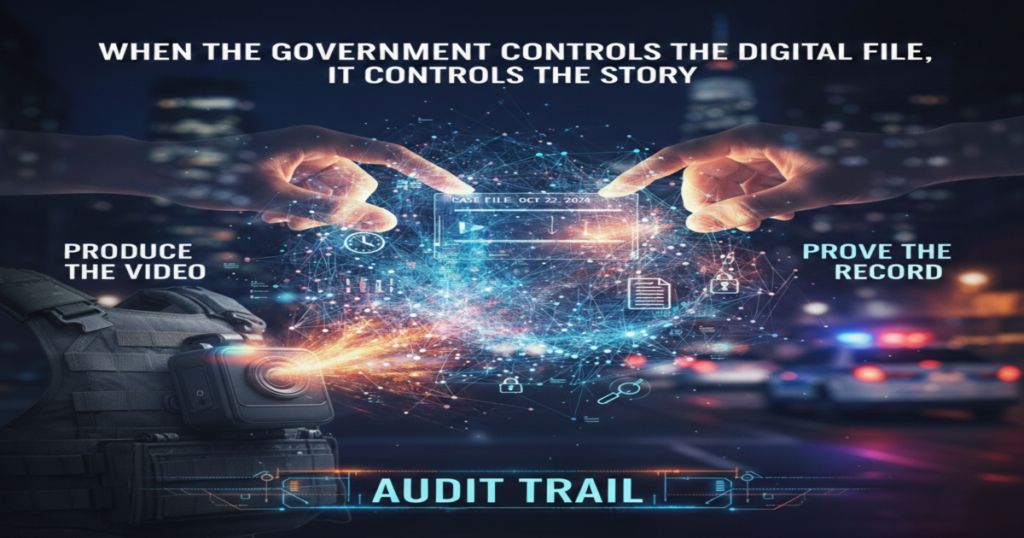
Why “transparency” is conditional without producible audit trails
Executive Summary
This thought-piece continues the line of analysis I developed in my prior work on body-worn cameras, where I used the New York City Police Department as the case study. I chose NYPD again for the same reason: its scale makes the evidence pipeline visible. In a department of that size, “the video” is not a casual artifact. It is the output of a managed system—an institutional workflow involving activation decisions, categorization choices, review chains, tracking systems, disclosure routines, and escalation pathways. Those mechanics are not peripheral. They are where modern police accountability disputes now live.
But this piece is not an NYPD-only argument. NYPD is the lens, not the boundary. Body-worn cameras are now widely used across American law enforcement. National reporting reflects substantial acquisition and deployment across agencies and widespread adoption of formal body-camera policies. Yet the broader research record on effectiveness is mixed. Some studies show benefits, others show no impact, and some show unintended effects. That variation matters because it points to the real determinant of whether cameras deliver accountability: not the presence of devices, but the governance of the record system. The practical question is not “do they have cameras,” but “what kind of record system have they built around those cameras—and can it be tested when it matters?”
That question becomes urgent for a reason every juror understands, even if they have never heard the phrase “evidence pipeline.” When video is missing, incomplete, starts late, or ends early, the courtroom becomes less factual and more interpretive. People fill gaps. They supply assumptions. And in police cases, the institution has structural advantages in that interpretive space—because authority sounds coherent, procedure sounds reliable, and official confidence often substitutes for proof. This is how a missing minute becomes a verdict-maker. Not because the missing minute “proves” misconduct by itself, but because the absence converts a dispute about actions into a dispute about credibility, and credibility contests are where public trust goes to die.
That is why the title is not rhetorical. When the government controls the digital file, it controls the story. Control is exercised at the points the public rarely sees: when recording begins and ends; how an encounter is categorized; whether it is preserved as a complete artifact; who can access, view, or export; and how long it takes for the record to surface in public or in court. In a world where cameras are ubiquitous, the most consequential question is no longer whether something was recorded—it is whether the public can ever be sure it is seeing the whole record, and whether the system can prove what happened to the evidence after the encounter ended.
This is also where audit trails move from administrative trivia to civic infrastructure. Logs, metadata, trackers, access histories, and review documentation are not “back office” materials. They are the proof layer that determines whether transparency is real or conditional. Without producible audit trails, the public is asked to accept assurances—“this is all the footage,” “this is what exists,” “this is why it’s missing,” “this is why it starts late,” “this is why it ends early”—without the ability to test those statements. And transparency that depends on untestable assurances is not transparency. It is permission.
This thought-piece reframes the accountability demand from “produce the video” to “prove the record.” It explains why NYPD is a useful case study and why the problem extends across federal, state, and local agencies regardless of size. It then lays out how digital-file control operates in practice—through capture, classification, preservation, access, and timing—and why meaningful public ownership of the record requires integrity artifacts that can be produced, reviewed, and challenged. The aim is not to attack the idea of cameras. The aim is to restore what cameras were supposed to create: shared facts. Because without a provable record system, cameras do not settle disputes. They simply relocate them into the evidence pipeline—where the institution holds the keys.
I. Why NYPD Is the Case Study—but the Problem Is National
I’ve used the New York City Police Department as the case study across these body-worn camera thought-pieces for a simple reason: scale exposes structure. In a department with a massive footprint, the body-camera program cannot plausibly be understood as “a video” that someone retrieves when asked. It is a managed ecosystem—an operational pipeline with policies, classifications, internal reviews, tracking systems, and disclosure routines. Those internal mechanics are not background noise. They are where “transparency” is either made real or quietly neutralized.
NYPD is also a useful case study because it sits at the intersection of the two worlds that define modern accountability: public legitimacy and adversarial testing. A large agency does not just record; it must store, sort, review, and produce at volume. That volume forces the institution to build systems—formal tracking tools, supervisory processes, standard operating routines—because without systems, the program collapses under its own weight. Those systems, in turn, become the real object of dispute. Not because the camera is irrelevant, but because the camera is only the first step. What matters next is what the institution does with what it captures, and whether it can prove that it handled the record with integrity.
But the thesis of this piece is not “NYPD is uniquely problematic.” NYPD is the lens, not the boundary. The concepts in this piece apply to any law enforcement agency—federal, state, or local—regardless of size, because the moment an agency adopts body-worn cameras it inherits the same set of governance questions. Who decides when recording begins and ends? Who decides how an encounter is categorized? Who decides what is preserved, for how long, and under what retention rules? Who has access to view and export? How long does it take for the record to surface when the public demands it or when a court compels it? Those questions do not disappear in smaller agencies. In some ways they become sharper, because smaller agencies often have fewer resources for storage, staffing, quality assurance, and independent oversight—the very infrastructure that makes “transparency” more than a slogan.
National reporting reflects a reality that should end the temptation to treat body-worn cameras as a niche reform experiment: they are now widely used across U.S. law enforcement. There has been substantial acquisition and deployment across general-purpose agencies, with higher adoption rates in larger departments, and broad use of formal body-camera policies. That means the BWC story is no longer a New York story or a big-city story. It is an American story, unfolding across sheriffs’ offices, suburban departments, state police agencies, and specialized units that interact with the public under color of law.
At the same time, national research summaries and clearinghouse evaluations consistently point to a second reality: the evidence on “effectiveness” is mixed. Some programs show improvements in certain outcomes, others show no measurable effects, and some show tradeoffs or unintended consequences. That mixed record is not an argument against cameras. It is a warning against magical thinking. It suggests that body-worn cameras do not produce accountability by their mere presence. Outcomes depend on policy design, implementation discipline, supervision, and the integrity infrastructure that prevents the record from becoming optional at the moment it matters most.
This is where longitudinal, agency-level analysis becomes especially important to the thesis of this piece. When researchers examine outcomes over time and across agencies, a pattern emerges that mirrors what litigators already know from practice: the effects of body-worn cameras vary with the strength of activation requirements and the degree to which discretion is constrained. In other words, the program’s governance architecture—the rules that determine when the camera “exists,” and whether the system enforces those rules—often matters more than the hardware itself.
That is why NYPD is a powerful case study and why the underlying theory travels. When the government controls the digital file, it controls the story. It controls the story not only through what happened on the street, but through what happens after: the administrative and technical pipeline that determines what becomes “the record,” what is missing, what is late, what is partial, what is categorized into obscurity, and what is produced only after escalation. That is not a uniquely New York dynamic. It is a structural feature of any institution that records its own use of power and retains unilateral control over the evidence system that mediates public access and judicial scrutiny.
So the purpose of Section I is to set the terms honestly. NYPD is the case study because it makes the pipeline visible. The problem is national because the pipeline exists everywhere cameras exist. And the stakes are universal because the legitimacy of government power now turns on a question the public has every right to ask: if this record is supposed to be public, why does it so often behave like institutional property until someone forces the system to prove what it did with the file?
Section II answers that question by defining “ownership” as a matter of control—control over existence, completeness, access, timing, and interpretation—and explaining why the government’s control over those levers is the reason transparency remains conditional without producible audit trails.
II. Ownership Isn’t Philosophy—It’s Control
When people hear “public record,” they think they understand the relationship. The government acts in public. The government records the act. The record belongs to the public. That’s the moral intuition behind transparency, and it’s why body-worn cameras were embraced as a legitimacy tool. The camera was supposed to move the system away from contested narratives and toward shared facts.
But “ownership” in the real world is not a moral intuition. It is a set of controls.
If you want to know who owns the record, don’t ask who paid for the camera. Don’t ask who wore it. Don’t ask who claims it promotes trust. Ask who controls the levers that determine what the digital file becomes. In a body-camera system, those levers are not abstract. They are procedural. They are administrative. They are operational. And whoever holds them can, without ever “editing” a frame, determine what the public and the court are allowed to treat as the truth.
That is what this thought-piece means by ownership: the power to decide what exists, what is preserved, what is produced, and when.
Start with existence. In the physical world, the encounter happened regardless of whether it was recorded. In the evidentiary world, the encounter becomes legible only if the system created a record of it. The first ownership lever is therefore the activation moment—the moment the government decides whether the record will exist in the form the public expects. That decision can be intentional or inadvertent, but the effect is the same: if the record does not exist, the institution controls the narrative space because everyone else is forced into inference.
Now add completeness. Even when a recording exists, the most important parts of a contested encounter are often the beginning and the end: the approach, the escalation, the moment force begins, and the resolution—handcuffing, medical attention, post-incident statements, stabilization. A digital file that starts late or ends early is not merely incomplete; it is narrative-shaping. It narrows what can be proven and expands what must be assumed. The second ownership lever is therefore continuity—whether the record captures the full story or only a fragment that must be interpreted.
Then comes classification. Classification sounds administrative, but it is one of the most powerful tools of control in a digital evidence system. How an encounter is tagged, categorized, associated with an incident type, or linked to a request can change the record’s treatment inside the institution. Classification can affect where a file is routed, how quickly it is located, what review obligations attach, what retention rules apply, and how the institution describes the record to outsiders. You can call it “metadata,” “categorization,” or “tagging,” but the power is the same: classification is how a system turns raw recordings into governed evidence—and it can also be how a system hides complexity behind administrative labels.
Preservation is the next control lever, and it is where transparency promises often quietly die. Preservation is not simply storage. It is a set of retention choices and hold mechanisms that determine whether the record remains available when the public asks, when a lawyer demands, or when a court compels. Preservation is what separates “we recorded it” from “we can produce it.” Without robust preservation discipline, transparency becomes a short-lived opportunity rather than a durable public right.
Access is another lever the public rarely sees but always experiences. Who inside the institution can view the footage? Who can export it? Who can decide what is responsive? Who can frame a denial, a delay, or a partial release as justified? Access is not only about permission; it is about workflow authority. In a system where access is tightly controlled, the institution holds the practical ability to slow the truth down, fragment it, and force outsiders into procedural escalation.
Finally, timing is the lever that turns control into narrative power. Timing determines what the public debates today, what a plaintiff can prove before a motion deadline, what a family learns before the political moment passes, and what a jury believes when confronted with an incomplete file months or years later. Delay is not merely inconvenience. In accountability disputes, delay is leverage. It allows institutional narratives to harden before evidence disrupts them. It allows public attention to fade. It allows the human memory of witnesses to erode. Timing, in other words, is one of the most consequential ways the government controls the story without ever touching the content of the recording.
The Five Levers of Narrative Control
Ownership is not defined by who pays for the server; it is defined by who manages the Lifecycle of the File. Without a producible audit trail, each of these levers serves as a point where the “shared fact” can be neutralized.
| Control Lever | The Institutional Action | The Narrative Impact | The Audit Trail Necessity |
| Existence | Activation / Deactivation | Determines if a fact is “legible” or “inferred.” | Trigger Metadata: To prove if deactivation was manual or a system timeout. |
| Completeness | Buffer / Late Start / Early Cut | Creates “interpretive gaps” where institutional credibility fills the void. | Device Logs: To verify the exact millisecond of start/stop commands. |
| Classification | Tagging / Metadata Labeling | Determines the file’s visibility and its “pathway” through the system. | Edit History: To see if a “Use of Force” tag was changed to “Routine Patrol.” |
| Preservation | Retention Rules / Deletion | Moves the record from a “Public Right” to a “Short-lived Opportunity.” | Purge Records: To prove if deletion followed policy or was an “anomaly.” |
| Access & Timing | Internal Review / Disclosure Delay | Allows institutional stories to “harden” before the evidence disrupts them. | Access Logs: To identify who “pre-viewed” footage before writing their reports. |
This is why transparency is conditional without producible audit trails. Without the proof layer—logs, trackers, access histories, review records, and internal handling documentation—outsiders cannot verify how these levers were used in a particular case. They can only accept assertions. “This is all the footage.” “This is why it starts late.” “This is why it ends early.” “This is why it’s missing.” “This is why it can’t be produced yet.” These statements may be true in a given instance, but without an auditable record of how the system operated, they remain narrative claims rather than proven facts.
And that is the ownership paradox at the heart of the body-camera era. The record is created in public space, under public authority, to justify public power. Yet the record behaves like institutional property unless the institution can be forced to disclose not just the video, but the integrity artifacts that prove what happened to the file after the encounter ended.
So Section II gives the reader a disciplined definition: ownership equals control over existence, completeness, classification, preservation, access, and timing. Those are the levers through which a digital file becomes a story. If the government holds those levers and the audit trail is not producible, then transparency is not a right—it is a discretionary outcome.
Section III will take this definition and make it concrete by mapping the five control gates of the digital file—capture, classification, preservation, access, and timing—showing how each gate shapes what the public and the courts are allowed to treat as reality.
III. The Five Control Gates of the Digital File
If Section II defined ownership as control, Section III shows the mechanism of that control. Think of a body-worn camera program not as a device program but as a gate system. The public sees the output—sometimes a clip, sometimes a headline, sometimes nothing at all. But what determines the output is what happens at the gates. Each gate is a decision point where the record can be made whole, made partial, made late, or made unprovable. None of this requires dramatic misconduct. It only requires that the institution retains unilateral control over the process and that the proof layer—the audit trail—is not consistently producible.
The first gate is capture. Capture is where the record is born, and it is the most obvious gate because it happens on the street. The public understands activation in the simplest terms: camera on, camera off. But capture is more than an on/off switch. Capture includes when recording starts, whether it begins before the key moments of escalation, whether it continues through the use of force, and whether it runs long enough to capture the resolution. Capture also includes the quiet ways context disappears—late activation that begins after the crucial moment, early deactivation that ends before the encounter resolves, obstructed perspective, and the loss of pre-contact context that would allow a factfinder to understand what led to force.
Capture is also the gate most likely to be explained away after the fact. When a recording doesn’t exist or doesn’t cover the full encounter, the institution can offer a vocabulary of benign-sounding explanations: malfunction, battery, human error, stress, chaos, forgetfulness. Some of those explanations may be true. The governance problem is that without integrity artifacts, the explanation is untestable. Capture gate failures are therefore not merely operational failures. They are narrative opportunities. They create the evidentiary vacuum that forces the factfinder back into the credibility contest cameras were supposed to reduce.
The second gate is classification. Classification is the most underestimated control point in the entire system because it operates quietly, behind the scenes, and sounds administrative. But classification is how the institution decides what the file is. It’s where the recording gets tagged to an incident type, categorized into a system, associated with a request, routed to a unit, and placed into a workflow that triggers—or fails to trigger—review obligations. Classification choices can affect how easily footage is found, how it is retained, how it is prioritized, and how it is described later. A recording treated as routine may move differently than a recording treated as force-related. A recording categorized incorrectly may never receive the review it should have received. A recording tagged in a way that narrows the response can become a mechanism for partial disclosure. Classification gate failures do not look like censorship. They look like administration. But administration is precisely how modern institutions manage narrative without appearing to manage it.
The third gate is preservation. Preservation is where transparency either becomes durable or collapses into a fleeting opportunity. Preservation is not simply storage; it’s the retention architecture and the hold mechanisms that determine whether a file remains available when the public asks or when litigation compels. If preservation is robust, the record can be produced even months or years later. If preservation is weak, the record can disappear through ordinary system processes and then reappear only as an explanation. Preservation failures are especially corrosive because they are often irreversible. Once a record is not preserved, the system cannot reconstruct what was never retained. And when the system cannot reconstruct, the institution’s story becomes insulated from contradiction. Preservation is therefore a central ownership lever: it determines whether the record remains public in any meaningful sense or whether it becomes a temporary window that closes before accountability can begin.
The fourth gate is access. Access is the practical reality of who can see the file, who can export it, who can review it, who can determine what is responsive, and who can delay or deny production. Access is what turns a file into a controlled asset. Even if capture is perfect and preservation is strong, access can still be used to shape narrative. A system can respond slowly. It can produce partial outputs. It can require escalation. It can force requesters to appeal or litigate. Access is the gate through which the public experiences transparency as either a routine right or a conditional privilege.
Access is also where audit trails are most decisive. If the public must rely on institutional statements about what exists and what has been produced, the institution is functionally asking the public to trust the gatekeeper. But access histories and handling records—who viewed, who exported, who marked, who routed, who decided—turn gatekeeping into something that can be audited. They shift the discourse from “believe us” to “show us.”
The fifth gate is timing. Timing is the quiet weapon of administrative control. Timing determines whether evidence enters the public sphere while it can still shape understanding or whether it arrives after narratives have hardened. Timing determines whether a plaintiff can investigate before deadlines, whether a family can confront an official story before public attention fades, whether a newsroom can correct misinformation while the story is still alive. Timing is what makes transparency either meaningful or ceremonial.
The Audit Conclusion: From “Believe Us” to “Show Us”
| The Gate | The Institutional Claim (The “Trust Me” Model) | The Integrity Artifact (The “Audit” Model) |
| Capture | “The battery died.” | System Pulse Logs: Proving device health and power status. |
| Classification | “It was a clerical error.” | Audit Logs: Showing who changed the tag and when. |
| Preservation | “It was automatically purged.” | Retention Metadata: Showing why a “Hold” was never placed. |
| Access | “Only authorized personnel saw it.” | User Access History: A line-by-line log of every “View” event. |
| Timing | “The redaction process takes time.” | Production Tracking: Showing the actual time spent on the file vs. the delay. |
Timing also changes how people interpret missingness. The longer a record is delayed, the easier it becomes for institutional explanations to sound reasonable. Delay normalizes absence. It trains the public to accept that accountability is slow and that evidence is complicated. Meanwhile, the human consequences are immediate: reputations are shaped, public perceptions crystallize, and trust erodes in the interval between event and disclosure. In that sense, timing is not a technical metric; it is narrative leverage.
These five gates—capture, classification, preservation, access, and timing—are the machinery of control over the digital file. And this is why the subtitle of this piece is not rhetorical: transparency is conditional without producible audit trails. If audit trails are not available, the public cannot test how each gate was handled in a specific incident. The public can only accept the institution’s explanation. And once the public is reduced to accepting explanations, ownership has shifted. The record is no longer a public asset. It is an institutional narrative presented to the public.
Section III therefore clarifies the next move. The solution is not simply more cameras. It is governance that forces the system to generate integrity artifacts at each gate—proof of capture compliance, proof of classification decisions, proof of preservation holds, proof of access events, and proof of timing decisions. Without those artifacts, the public is left with the same condition that existed before cameras: contested stories resolved by authority. Cameras were supposed to change that. They still can—but only if the gate system is forced to prove the record.
IV. The Human Dynamic: When the Record Is Incomplete, Credibility Becomes the Evidence
The hardest truth to communicate about body-worn cameras is not technical. It’s human. Even sophisticated readers—lawyers included—can slip into the fantasy that footage is a neutral referee. But footage is only as neutral as the record system that produces it. And when the record is incomplete, the case does not stay a dispute about conduct. It becomes a dispute about credibility.
That pivot matters because credibility is not evenly distributed in police encounters. The uniform comes with institutional authority. The government comes with procedural confidence. The officer’s narrative often arrives packaged as official, orderly, and presumptively coherent. The civilian’s narrative often arrives as messy, emotional, and fragmented—because trauma and fear fragment memory. In a system that truly delivered shared facts, those asymmetries would shrink. In a system that delivers partial records, those asymmetries expand.
This is the human consequence of the five control gates. A capture gate failure—late activation, early deactivation, no recording—does not merely remove information. It changes the psychology of judgment. The factfinder is deprived of context and forced to reconstruct it. The factfinder then does what humans always do: fills in the blanks with what feels plausible. And “plausible” is not neutral. It is shaped by cultural scripts about danger, authority, defiance, and “what must have happened.”
This is why missing minutes are not just missing minutes. They are meaning-making engines. They create a vacuum that invites the institution to narrate the gap in the language of reasonableness and training and workload. And because the public is primed to believe that the government keeps records competently, the institution’s explanation often lands as “common sense.” Meanwhile, the civilian’s explanation—fear, panic, confusion, pain—lands as “uncertain.” The system that was supposed to reduce the credibility gap ends up reinforcing it.
In court, this dynamic shows up in a predictable sequence. A clip is shown. Someone says, “This is what happened.” Then the opponent says, “But the video starts after the key moment,” or “The video ends before the resolution,” or “The audio doesn’t capture the command,” or “There is no recording at the moment force begins.” At that point, the case stops being about what the video shows and becomes about what the video does not show. And once the dispute is about absence, everyone is fighting over narrative. The government argues inadvertence, malfunction, stress, chaos. The plaintiff argues inference, pattern, and institutional control. The factfinder is left deciding which explanation is more believable without an objective way to test it.
This is where audit trails are not just administrative documents; they are the moral spine of modern transparency. Without them, the public is forced into a posture of faith. Faith in the completeness of the record. Faith in the institution’s explanation for gaps. Faith in the timing of production. Faith that what was produced is what exists. Faith is not accountability. Faith is what institutions ask for when proof is unavailable.
The psychological cost of conditional transparency is wider than any single lawsuit. It produces two corrosive social results at once. It teaches the public that “truth” is something you have to fight to access, which makes the public less likely to trust official narratives even when they are accurate. And it teaches institutions that delay and fragmentation can reduce accountability pressure, which incentivizes gatekeeping behavior even without any explicit intent to conceal.
The dynamic is especially destructive because it forces the public into polarized interpretations. One side treats missing footage as definitive proof of concealment. The other side treats missing footage as inevitable imperfection. Both instincts are understandable. Neither is a substitute for testable integrity. The only path out of that polarization is a record system that can prove how it operated—so the public does not have to guess whether an absence is innocent or strategic.
This is also where the choice of NYPD as a case study becomes pedagogically useful. A large agency cannot credibly claim it has no pipeline. It has to have one. It must have tracking systems, standardized workflows, and internal handling processes just to manage volume. That makes the core question sharper, not softer: if the system is robust enough to manage the records internally, why is the public so often left with an incomplete record externally? Why does access feel conditional? Why do disputes still hinge on missingness rather than shared facts?
That question is not a rhetorical flourish. It is the public’s demand for legitimacy. And legitimacy today is not built by telling people to trust the camera. Legitimacy is built by proving that the record system is governed in a way that prevents missingness from becoming narrative power.
So Section IV is the emotional and civic hinge of this piece. It explains why this is not a “data governance” debate. It is a human fairness debate. When the record is incomplete, the system asks ordinary people—jurors, judges, families, communities—to allocate the risk of missingness. And when the government controls the file, it is the government that has the greatest ability to prevent missingness from dominating the outcome.
The rest of this thought-piece is therefore not about demanding perfection. It is about demanding proof. If transparency is the promise, the audit trail is how the promise is kept. Without producible audit trails, the government retains the ability to control the story not only through what happened, but through what can be proven happened.