


“Reverse discrimination” is not a term recognized by federal civil-rights law. It does not appear in Title VII of the Civil Rights Act of 1964, in its legislative history, or in the enforcement regulations promulgated under it. It is not a doctrinal category applied by courts, nor is it an evidentiary standard used by enforcement agencies. It is a political label—one that emerges predictably when civil-rights enforcement begins to constrain discretion that has long gone unexamined.
Title VII is explicit in both its scope and its restraint. It prohibits employers from discriminating against any individual with respect to compensation, terms, conditions, or privileges of employment because of race, color, religion, sex, or national origin. The statute does not rank protected classes. It does not assign historical weights. It does not calibrate liability based on prior advantage or disadvantage. It regulates conduct, not identity.
That neutrality was intentional. Congress understood in 1964 that discrimination was not merely episodic or interpersonal, but structural—embedded in hiring pipelines, promotion practices, evaluation criteria, and informal networks of power. The statute was therefore designed not to preserve existing distributions of opportunity, but to disrupt them where they were produced by unlawful criteria. Title VII did not promise continuity. It promised legality.
From its enactment forward, White plaintiffs were fully protected by the statute. There was no period in which civil-rights law applied only to certain racial groups, and there has been no subsequent doctrinal reversal. Courts have always adjudicated discrimination claims brought by White employees under the same frameworks applied to all others: disparate treatment, disparate impact, and retaliation. The statute has never recognized a forward or reverse direction of discrimination. There has only been compliance or violation.
The persistence of the “reverse discrimination” narrative therefore does not arise from the text of the law. It arises from resistance to what the law requires.
That resistance has a consistent structure. It begins with an unstated baseline assumption: that pre-enforcement outcomes were neutral, merit-based, and therefore presumptively fair. Under that assumption, any regulatory intervention that alters outcomes is treated as distortion rather than correction. Oversight becomes favoritism. Accountability becomes bias. Equality becomes injury.
Civil-rights law rejects that premise. Title VII does not ask whether an employer’s workforce reflects historical norms or inherited expectations. It asks whether employment decisions are made according to lawful criteria, applied consistently, and free from prohibited bias. When enforcement alters outcomes, that alteration is not evidence of discrimination. It is evidence that prior discretion operated without constraint.
The modern backlash against diversity, equity, and inclusion initiatives is best understood through this lens. Diversity, Equity, and Inclusion (DEI) has become a proxy term—used not to describe a single policy or legal requirement, but to stand in for compliance itself. Practices that discipline discretion—standardized evaluations, expanded recruitment, pay audits, bias training, internal reporting mechanisms—are rebranded as ideological impositions rather than as risk-management tools grounded in settled law.
That reframing has gained traction not because the law has changed, but because enforcement has matured. As overt exclusion has given way to structural bias, civil-rights oversight has shifted from policing slurs to scrutinizing systems. That shift narrows institutional maneuvering room. It exposes decision-making that was previously shielded by informality. It makes outcomes legible.
It is at that point—when discretion is constrained and explanation is required—that claims of “reverse discrimination” reliably surface.
Recent political rhetoric and selective readings of Supreme Court decisions have attempted to give this backlash doctrinal cover. They suggest that civil-rights law has overcorrected, that enforcement has exceeded statutory authority, and that White men now face systemic disadvantage as a result. Those claims collapse under even minimal legal and empirical scrutiny.
The Supreme Court has not recognized a doctrine of “reverse discrimination.” It has not held that White men are structurally disadvantaged in the labor market. It has not altered the substantive standards governing discrimination claims. What it has done, most recently, is correct lower-court deviations from statutory text by reaffirming that Title VII applies equally to all plaintiffs, without heightened pleading burdens for any group. That clarification restored neutrality; it did not validate backlash narratives.
If civil-rights enforcement had in fact produced systemic disadvantage for White men, that disadvantage would be visible in the places the law already measures. Structural exclusion does not hide. It appears in earnings data, unemployment rates, occupational access, promotion patterns, and retaliation claims. Those indicators are tracked routinely by the Bureau of Labor Statistics and enforced daily by the Equal Employment Opportunity Commission.
They do not show a reversal.
White men remain at or near the top of the labor-market hierarchy in earnings and occupational concentration. Black women—situated at the intersection of race and sex—continue to experience one of the most persistent and measurable economic penalties in the workforce. Retaliation remains the most frequently alleged basis of discrimination charges, signaling not the disappearance of bias, but institutional resistance to accountability.
The enforcement posture of the EEOC reflects this reality. The agency’s strategic priorities focus on systemic discrimination, pay equity, harassment, retaliation, and emerging risks such as algorithmic bias. These priorities are not ideological. They are responsive to patterns observed across thousands of investigations and millions of data points. If discrimination had meaningfully reversed, enforcement would reflect that shift. It does not.
The claim of “reverse discrimination” therefore fails on every axis that matters. It is unsupported by statute. It is unsupported by doctrine. It is unsupported by labor-market data. And it is unsupported by federal enforcement reality.
What it reflects instead is a familiar dynamic in the history of civil-rights law: when oversight becomes effective, it is recast as excess. When discretion is constrained, constraint is reframed as injury. And when equality begins to operate as a rule rather than an aspiration, those accustomed to insulation experience that rule as loss.
This analysis proceeds from the law as written and the data as measured. It does not ask whether individual White employees can experience discrimination—they can, and the statute protects them. It asks whether the claim that civil-rights enforcement and DEI have produced systemic disadvantage for White men is legally or empirically defensible.
It is not.
Title VII Does Not Recognize “Reverse Discrimination”
The claim that civil-rights law now operates “in reverse” depends on a premise that Title VII itself rejects: that the statute was designed to preserve existing distributions of opportunity so long as decision-making appeared facially neutral. That was never the project. Title VII was enacted to interrupt entrenched patterns of exclusion that had been normalized through discretion, custom, and informal judgment. Its neutrality lies in who it protects, not in what it preserves.

The statute’s operative language has remained unchanged since 1964. It prohibits discrimination against any individual because of race, color, religion, sex, or national origin. That phrasing is not merely inclusive; it is limiting. It constrains the bases on which employment decisions may lawfully rest. Title VII does not guarantee outcomes. It regulates process. Employers may choose among qualified candidates—but only on lawful grounds.
From the outset, Congress understood that regulating process would change outcomes. That was not collateral damage. It was the point.
Discretion Was the Target
The legislative debates surrounding Title VII make clear that opposition was not rooted in a fear of forced quotas, but in anxiety over constrained discretion. Critics warned that prohibiting race- and sex-based decision-making would interfere with “common sense” judgments about fit, leadership, and institutional culture. Supporters responded—correctly—that those judgments had functioned as gatekeeping mechanisms precisely because they were insulated from scrutiny. Title VII did not abolish discretion. It subjected discretion to law.
That distinction is central, because modern invocations of “reverse discrimination” rely on collapsing discretion into merit. When enforcement disrupts outcomes produced by discretionary systems, the disruption is treated as evidence of bias rather than as proof that discretion was operating unlawfully. Title VII rejects that framing. It treats unexplained disparities not as natural, but as suspect.
Nothing in the statute suggests that discrimination only runs in one direction. Nothing suggests that enforcement should be relaxed once formal equality is declared. To the contrary, Title VII was drafted with the expectation that discrimination would adapt—and it empowered courts and agencies to adapt in response.
History proved that expectation prescient.
Early enforcement targeted explicit exclusion: segregated job postings, categorical hiring bans, and seniority systems that locked in the effects of prior segregation. As those practices fell, discrimination migrated. Employers turned to facially neutral criteria—subjective evaluations, informal recruitment, discretionary promotions, opaque compensation systems—that reproduced exclusion while evading detection.
Title VII was written broadly enough to reach those practices. Courts recognized disparate impact doctrine not because neutrality is unlawful, but because neutrality can conceal exclusion. Disparate impact does not require proof of animus. It requires proof that a practice disproportionately excludes protected groups and is not justified by business necessity.
That doctrinal development is fatal to the “reverse discrimination” narrative.
The Ames Decision Clarifies—It Does Not Reverse—Title VII
Recent commentary has seized on Supreme Court decisions to suggest that the Court has endorsed a theory of systemic disadvantage for White or majority-group plaintiffs. That reading collapses under scrutiny, particularly in light of the Court’s unanimous decision in Ames v. Ohio Department of Youth Services.
In Ames, the Court rejected a line of lower-court doctrine that imposed heightened evidentiary burdens on majority-group plaintiffs at the prima facie stage. The Sixth Circuit had required such plaintiffs to show “background circumstances” suggesting that the employer was the rare institution that discriminates against the majority. The Supreme Court vacated that rule as incompatible with the text of Title VII.
The holding is narrow, textual, and clarifying. It does not recognize “reverse discrimination” as a distinct phenomenon. It does not lower the substantive bar for liability. It does not endorse claims that DEI initiatives are presumptively unlawful. It simply restores statutory symmetry: the same evidentiary standards apply to all plaintiffs.
That is not doctrinal revolution. It is statutory housekeeping.
As Justice Jackson explained, Title VII protects individuals, not groups. Courts are not permitted to impose additional burdens based on assumptions about who is more or less likely to experience discrimination. The statute’s neutrality runs in one direction only: equal access to its protections. The evidentiary burden remains the same. The ultimate question remains the same. The law asks whether an adverse action was taken because of a protected characteristic.
Ames therefore dismantles, rather than validates, the backlash narrative. It rejects the idea that courts may recalibrate Title VII based on demographic expectations. But it leaves untouched the core enforcement architecture: disparate treatment, disparate impact, systemic remedies, and injunctive relief.
In short, Ames reaffirms that Title VII is not a cultural referendum. It is a conduct-regulating statute.
Neutral Standards, Unequal Baselines
The persistence of the “reverse discrimination” myth flows from a basic category error: confusing neutrality of rule with neutrality of effect. Title VII does not promise that enforcement will leave all groups equally situated relative to historical baselines. It promises that decision-making going forward will be constrained by law.
That promise produces friction.
Consider seniority systems. Title VII permits bona fide seniority systems even when they perpetuate past inequality, but it prohibits the adoption of new practices that replicate those effects under the guise of neutrality. That balance reflects a legislative judgment: the law will not retroactively undo history, but it will not allow history to continue unchecked.
The backlash narrative ignores that distinction. It treats any intervention that alters legacy advantage as affirmative discrimination rather than as the cessation of unlawful preference. It assumes the status quo is neutral and regulation is distortion. Title VII assumes the opposite.
That assumption is not ideological. It is empirical.
Enforcement Is Not Preference
At no point has Congress amended Title VII to create a category of “reverse discrimination.” At no point has it instructed courts or agencies to weigh claims differently based on the claimant’s demographic status. When lower courts attempted to do so, the Supreme Court rejected the effort—as it did in Ames.
This does not signal newfound concern for majority-group disadvantage. It reaffirms that the statute does not permit courts to rewrite evidentiary rules based on social narratives. Title VII protects individuals, not myths.
This is why efforts to recast DEI compliance measures as unlawful preferences fail as a matter of law. Title VII does not prohibit employers from auditing compensation systems, standardizing evaluation criteria, or expanding applicant pools. It prohibits decision-making that relies on protected characteristics rather than job-related factors. Compliance infrastructure designed to prevent discrimination does not violate the statute simply because it acknowledges inequality.
Indeed, much of what is now labeled “DEI” originated as remedial architecture imposed through consent decrees, enforcement actions, and litigation settlements. These were not ideological projects. They were liability responses.
When institutions dismantle those systems in response to political pressure, they are not returning to neutrality. They are abandoning safeguards that Title VII enforcement has repeatedly deemed necessary.
The Core Error of the Backlash Thesis
The legal fiction of “reverse discrimination” ultimately depends on treating equality as a zero-sum contest. Under that view, any gain by one group must correspond to a loss by another. Title VII rejects that logic. It does not allocate opportunity. It regulates conduct.
Gains occur when exclusionary practices are dismantled. Losses occur only when advantage depended on illegality.
The statute does not apologize for that outcome. Nor does it require courts to. Title VII was never intended to preserve comfort. It was intended to impose accountability. When accountability disrupts legacy advantage, the disruption reflects enforcement, not discrimination.
The backlash is therefore not about equality going too far. It is about discretion being narrowed.
Title VII anticipated that resistance. It was drafted broadly enough to withstand it.
Labor-Market Data Does Not Show White Male Disadvantage
If civil-rights enforcement and DEI initiatives had produced systemic disadvantage for White men, that disadvantage would be visible in the labor market. Structural exclusion does not require inference or narrative framing; it leaves a record. Earnings, unemployment, occupational concentration, promotion pipelines, and job stability are tracked continuously by the federal government. These indicators are descriptive, not ideological.
Taken together, they do not support the claim that White men are now disadvantaged as a class.
Earnings Data: The Hierarchy Has Not Reversed
Begin with earnings, where the backlash narrative most often asserts displacement.
Bureau of Labor Statistics data on median usual weekly earnings for full-time wage and salary workers shows a durable stratification, but not the one critics claim. In recent BLS reporting periods, Asian men—as an aggregate category—report the highest median weekly earnings, followed by White men, with Black men, Hispanic men, and women across groups earning less. This fact matters, and it must be stated plainly.
White men are not the top-earning group in the BLS median. Asian men are.

But that reality does not rescue the “reverse discrimination” thesis. It dismantles it.
First, White men continue to earn more than Black men, Hispanic men, White women, Black women, and Hispanic women. Black women, in particular, earn substantially less—often barely two-thirds of White men’s median weekly earnings for full-time work. Hispanic women earn even less. These gaps persist across economic cycles and do not disappear when education is held constant. They narrow modestly in some categories and then stall.
Second, the aggregate earnings position of Asian men does not reflect a redistribution produced by DEI or civil-rights enforcement. It reflects occupational and educational concentration, shaped by immigration patterns, credential sorting, and labor-market channeling. BLS’s “Asian” category is heterogeneous to the point of distortion: it aggregates subpopulations with dramatically different income distributions. High median earnings are driven disproportionately by concentration in technical, engineering, and professional roles—not by preferential treatment in promotion or compensation systems.
Third, even with Asian men at the top of the median, the relative position of White men has not deteriorated. If discrimination had meaningfully reversed, one would expect convergence or inversion between White men and historically disadvantaged groups. There is no such pattern. White men’s earnings remain structurally insulated relative to Black and Hispanic workers and to women.
The presence of Asian men at the top therefore undermines, rather than supports, the backlash claim. It shows that the labor market is shaped by sorting and stratification—not by a zero-sum transfer of advantage away from White men through DEI.
Occupational Concentration Explains the Distribution
This brings the analysis to occupational sorting, where structural advantage becomes clearest—and where the “reverse discrimination” claim collapses under scrutiny.
If White men were being displaced by civil-rights enforcement or DEI initiatives, that displacement would be visible in the occupational categories that carry (1) higher compensation, (2) stronger stability, and (3) greater authority. The BLS record does not show displacement. It shows stratification.
The BLS’s Labor force characteristics by race and ethnicity, 2023 (Report 1113) starts with a basic but indispensable baseline: in 2023, White workers comprised 76% of the labor force and 77% of all employed people. Black workers comprised 13%, Asians 7%, and Hispanic/Latino workers (of any race) 19%. That composition matters because “dominance” in authority-bearing positions is not assessed by anecdotes; it is assessed by where groups are concentrated across the occupational hierarchy.
The highest-paying major occupational category in the BLS framework is “management, professional, and related occupations.” In 2023, 59% of Asian workers were employed in that category, compared with 44% of White workers, 36% of Black workers, and 26% of Hispanic/Latino workers. Among men specifically, 60% of Asian men worked in management/professional roles, compared with 40% of White men, 30% of Black men, and 22% of Hispanic/Latino men. Those are not marginal differences. They are structural patterns that describe the distribution of high-status work.
But the key point for the thesis is what happens when “high-status work” is not treated as a single bucket and we examine where different groups are overrepresented at the level that typically signals authority, supervision, and institutional insulation. The same BLS report shows that White workers are disproportionately concentrated in multiple authority-coded categories and detailed occupations. For example, White workers account for 90% of construction managers, 92% of aircraft pilots and flight engineers, and 96% of farmers, ranchers, and other agricultural managers. Those are not entry-level roles. They are control roles—positions that carry supervisory or governance-like authority over labor, capital, or operational risk.
Asian workers, by contrast, show a different kind of concentration: very strong presence in specific professional pipelines that elevate median earnings, but do not automatically confer executive authority. The report notes, for example, that Asians comprise 36% of software developers, 24% of computer programmers, and 21% of pharmacists—all high-skill, high-pay occupations. That distribution explains why aggregate earnings tables often place Asian men at the top of the median. It also explains why median pay, standing alone, cannot be treated as a proxy for institutional dominance. A workforce can be heavily represented in elite technical roles while remaining constrained in leadership outcomes—an empirical pattern that the broader literature describes as the “bamboo ceiling.”
The “reverse discrimination” claim collapses here for a simple reason: the data does not show White men being pushed out of the occupations that function as institutional command posts. The report shows continued White overrepresentation in multiple authority-bearing detailed occupations and continued White plurality in the upper occupational tiers. What has changed, where it has changed, is diversification within segments of the professional labor market—not inversion of the decision-making hierarchy.
If DEI were operating as a systemic preference regime against White men, we would see it where it would have to show up first: the occupational distribution of authority and high-status work. The BLS record shows concentration, not displacement—entrenchment, not reversal.
The next section turns from occupation to the most unforgiving metric of all: unemployment and joblessness patterns across race and ethnicity, where structural advantage tends to reveal itself in downturns and recoveries alike.
Unemployment and Job Security Show No Reversal
Unemployment data reinforces the same conclusion, and the BLS numbers here are direct.
In 2023, the overall unemployment rate was 3.6%, but it varied sharply by race and ethnicity: Asian workers had a 3.0% unemployment rate; White workers 3.3%; Hispanic/Latino workers 4.6%; and Black workers 5.5%. That is not a narrow spread. It is a persistent ranking that undermines the idea that civil-rights enforcement has produced systemic job-market disadvantage for Whites.
The pattern holds when the lens narrows to adult men (age 20+), where backlash rhetoric most often claims “reverse” harm. In 2023, adult male unemployment was 3.1% for White men, 3.2% for Asian men, 4.3% for Hispanic/Latino men, and 5.3% for Black men. The claim that White men are now disadvantaged as a class would require the opposite ordering—or at least evidence of inversion during some sustained period. The BLS report describes long-standing differences and provides a 1973–2023 series precisely because these disparities do not appear only in a single year; they recur across cycles.
Job security shows up not only in who becomes unemployed, but in how long unemployment lasts. On that measure, the report highlights another structural reality: in 2023, the median duration of unemployment was 11.2 weeks for Asians and 10.3 weeks for Black workers, compared with 8.4 weeks for White workers and 8.2 weeks for Hispanic/Latino workers. That figure is important for the Asian-male analysis. It supports the point that high median earnings can coexist with distinct forms of vulnerability—longer unemployment duration and, in many cases, exposure to industry volatility or status-linked precarity. It also reinforces the central point: whatever the story is, it is not “White male disadvantage.” White workers, as a group, experienced a shorter median duration of unemployment than both Asians and Blacks in 2023.
Finally, the BLS report includes measures of detachment from the labor market that track discouragement and constrained opportunity. Black workers comprised 13% of the civilian labor force but 23% of those marginally attached to the labor force and 26% of discouraged workers. White workers, by contrast, were 76% of the labor force but 64% of the marginally attached—underrepresented among those pushed to the edge of labor-force participation. Those are structural indicators of who bears labor-market instability and who is more insulated from it.
Structural disadvantage shows up early in joblessness, deepens in detachment, and lingers in recovery. On the BLS measures that capture those realities, White men are not disadvantaged.
Promotion and Advancement Patterns Remain Unequal
Promotion data is often discussed as a matter of internal corporate pathways, but the BLS occupational distribution provides a population-level proxy for where advancement outcomes accumulate.
The same BLS report shows that White and Asian workers are far more concentrated in the highest-paying major occupational category—management, professional, and related—than Black and Hispanic/Latino workers. Again: 59% of Asian workers and 44% of White workers are in that top category, compared with 36% of Black workers and 26% of Hispanic/Latino workers. Among men, the spread is even starker: 60% of Asian men and 40% of White men are in management/professional roles, compared with 30% of Black men and 22% of Hispanic/Latino men.
Those gaps do not prove every mechanism that produces them, but they do prove the outcome: the concentration of high-status work remains unevenly distributed, and it is not distributed in a manner consistent with “reverse discrimination” against White men.
The same occupational tables also show how sorting channels different groups toward different risk profiles. In 2023, 27% of Black men and 21% of Hispanic/Latino men worked in production, transportation, and material moving occupations, compared with 17% of White men and 11% of Asian men. Hispanic/Latino men were also heavily concentrated in natural resources, construction, and maintenance occupations (27%), compared with 18% of White men, 10% of Black men, and 4% of Asian men. These are the jobs that tend to be more physically taxing, more cyclical, and more exposed to layoffs and injury. That is not a “preference” story. It is an allocation story.
In other words, the BLS data does not show promotion pipelines “flipping.” It shows high-status occupational concentration continuing to track race and ethnicity in predictable directions—with White men holding a large footprint in the upper tiers and Black and Hispanic workers disproportionately concentrated in roles with greater exposure to volatility and lower pay.
DEI does not create these distributions. The BLS record shows they preexist and persist.
Pay Gaps and Earnings Patterns Seal the Analysis
Earnings data from the same BLS report confirms the broader pattern—and it does so with numbers that are difficult to rhetorically evade.
In 2023, median usual weekly earnings for full-time wage and salary workers were $1,474 for Asians, $1,138 for Whites, $920 for Black workers, and $874 for Hispanic/Latino workers. When disaggregated by sex, the report provides the more relevant comparison for the thesis: White men earned a median of $1,225 per week; Black men $970; Hispanic/Latino men $915; and Asian men $1,635. Among women, White women earned $1,021, Black women $889, Hispanic/Latino women $800, and Asian women $1,299.
Two points follow directly from the data.
First, the claim that White men have been structurally disadvantaged by civil-rights enforcement is incompatible with their earnings position relative to Black and Hispanic workers. A “reversal” story would predict convergence or inversion. The BLS medians show neither.
Second, the “Asian earnings counterexample” does not rescue the backlash narrative, because the report itself explains why these comparisons are broad and do not control for skills, responsibilities, specialization, or educational attainment. The report also provides the occupational concentration mechanism that drives Asian earnings upward: Asians are far more concentrated in management/professional roles (59%) than any other group. That is an occupational distribution explanation, not evidence of institutional preference against Whites.
The BLS report is careful about causal claims; you should be too. But the distributional facts are sufficient for the argument: the labor market has not produced the signature outcomes one would expect if “reverse discrimination” were operating as a systemic disadvantage against White men.
What the Data Actually Shows
Taken together, the BLS record supports four propositions that are directly relevant to the thesis:
White and Asian unemployment rates are lower than Black unemployment, with Hispanic/Latino unemployment higher than White and Asian rates.
High-status occupational concentration remains uneven: 59% of Asians and 44% of Whites work in management/professional roles, compared with 36% of Blacks and 26% of Hispanic/Latino workers.
White workers are disproportionately represented in multiple detailed authority-coded occupations (for example, 90% of construction managers, 92% of pilots/flight engineers, 96% of agricultural managers).
Black workers are disproportionately represented among indicators of labor-market detachment: 23% of the marginally attached and 26% of discouraged workers while comprising 13% of the labor force.
That is not a portrait of reversal. It is a portrait of persistent structural disparity.
Black Women Bear the Most Persistent Economic Penalty
If the claim of “reverse discrimination” were grounded in reality, the groups historically positioned at the bottom of the labor market would show meaningful convergence. The BLS record shows the opposite: Black women remain subject to a measurable, persistent penalty across unemployment and earnings.
Start with unemployment. In 2023, the unemployment rate for Black women was 4.9%, compared with 2.8% for White women and 2.5% for Asian women. The gap is not explained away by “participation,” because Black women also participate in the labor force at high rates. Among adult women, the labor force participation rate for Black women was 63.2%, higher than White women (57.6%) and Asian women (59.9%). Among mothers living with children under 18, Black mothers participated at 79.5%, compared with 73.5% for White mothers, 70.7% for Asian mothers, and 66.1% for Hispanic/Latino mothers. That is the opposite of a “less attached” workforce story. It is a story of high labor-force attachment paired with higher joblessness risk.
Then earnings. In 2023, the median usual weekly earnings for Black women were $889, compared with $1,021 for White women and $1,225 for White men. Put plainly, Black women’s median weekly earnings were roughly 73 cents on the White male dollar on the BLS full-time weekly measure ($889 ÷ $1,225). That ratio is not a rounding error and not a narrative artifact. It is a measurable economic penalty.
Occupational distribution helps explain how these penalties persist. Black women are less concentrated than Asian and White women in management/professional work. In 2023, 42% of Black women were in management/professional roles, compared with 49% of White women and 58% of Asian women—a gap that tracks directly into earnings and advancement opportunity.
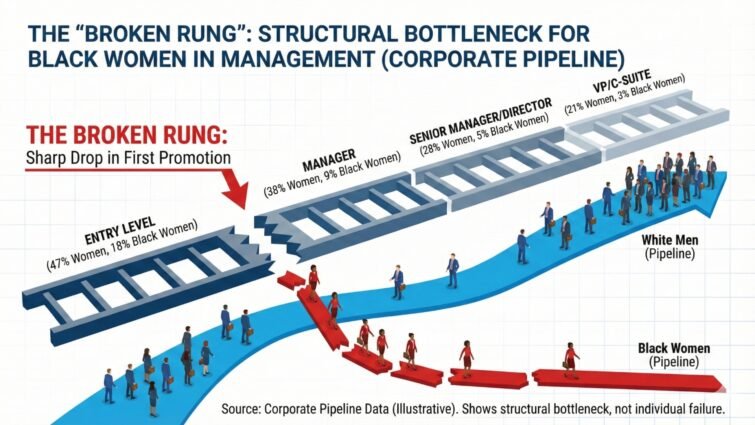
Finally, the BLS indicators of marginal attachment and discouragement sharpen the point that these disparities are structural, not episodic. Black workers (again) represent 23% of the marginally attached and 26% of discouraged workers despite being 13% of the labor force. This is what persistent labor-market disadvantage looks like when you measure it beyond rhetoric: higher joblessness, lower earnings, and higher detachment pressures despite strong participation.
The conclusion is not that DEI has created preference. The conclusion is that, even with decades of civil-rights law, the measurable penalties remain—especially for Black women. A labor market that continues to impose that penalty cannot plausibly be described as one in which discrimination has “reversed” against White men. The hierarchy has not flipped. The disparities have endured.
EEOC Enforcement Reality Contradicts the Narrative
If discrimination in the American workplace had meaningfully reversed—if White men were now systematically disadvantaged because civil-rights enforcement and DEI “went too far”—you would not have to divine that reversal from cable-news anecdotes or isolated lawsuits. It would show up where reality always shows up first: in volume, in patterns, and in enforcement triage.
The EEOC is not a cultural commentary shop. It is an intake-and-enforcement institution. It absorbs whatever the labor market produces, then spends scarce resources on what repeats, what clusters, and what can be proved.
That is why its FY 2024 record matters as a credibility test. And that record does not support the backlash story.
A. Start with scale: the pipeline is growing, not “overcorrecting”
In Fiscal Year 2024, the EEOC received 88,531 new charges—more than a 9% increase over FY 2023.
That growth matters for one simple reason: a workplace regime allegedly “tilted” against employers (or against White men) should produce less demand for enforcement, not more. Overcorrection is not supposed to generate a rising docket; it is supposed to generate compliance and settlement stability. Instead, the agency is reporting increased public demand across channels—553,000 calls and 90,000 emails—because the conflict is not receding.
B. The most common allegation is not “anti-White bias.” It’s retaliation.
If you want to know what the workplace looks like when someone invokes civil-rights law, look at the single dominant basis that keeps recurring year after year: retaliation.
Using the EEOC’s national charge table (FY 1997–FY 2024), retaliation under all statutes appears in 42,301 FY 2024 charges—about 47.8% of all charges filed that year.
That is not a rounding error. That is the governing fact pattern of modern civil-rights enforcement: the most common “discrimination story” is not initial exclusion; it is what happens after an employee complains, participates, reports, resists, or refuses to play along.
And the trend line is the point. In FY 1997, retaliation appeared in 18,198 charges (about 19.9%). By FY 2024, it is 42,301 (about 47.8%).
That arc is not the footprint of a system that has “gone too far” toward employees. It is the footprint of a system where too many workplaces still treat accountability as provocation.
A world of “reverse discrimination” against White men would not be anchored in a retaliation-dominant docket. Retaliation thrives in environments where employees fear consequences for naming discrimination—where institutions still enforce silence informally, even while praising equality formally.
C. Race, sex, disability, and age remain the core of the docket—and they remain large

The backlash narrative keeps trying to reframe enforcement as if the state is busy policing imagined slights against historically dominant groups. But the charge data shows what enforcement actually follows: recurring harm patterns that map onto the same protected categories Title VII and its companion statutes have always covered.
In FY 2024:
Disability appears in 33,668 charges (about 38.0%).
Race appears in 27,175 charges (about 30.7%).
Sex appears in 25,630 charges (about 28.9%).
Age appears in 15,714 charges (about 17.8%).
National origin appears in 7,473 charges (about 8.4%).
Two clarifications that strengthen—not weaken—the inference:
These categories can overlap in a single charge (one filing can allege retaliation + race + disability, etc.). So the percentages are not meant to add to 100; they are meant to show what bases repeatedly appear in real disputes.
The data is not organized by the claimant’s demographic identity. It is organized by alleged unlawful conduct. That matters because the popular talking point is that enforcement “favors” certain groups. But this isn’t a preference ledger—it’s an allegation ledger. The Commission is tracking what employers are being accused of doing, not which group is supposed to be winning a cultural argument.
D. Enforcement is not just intake: litigation and money follow provable violations
The EEOC does not litigate to perform politics; it litigates because it believes it can prove violations and justify remedies.
In FY 2024, the EEOC reports:
111 merits lawsuits filed (including 13 systemic suits).
132 merits lawsuits resolved, with a successful outcome in 97% of suit resolutions.
Monetary recovery totals that are not symbolic:
Over $469.6 million for private-sector and state/local victims through administrative resolution,
More than $190 million for federal employees/applicants, and
Over $40 million tied directly to litigation resolutions.
This is the practical answer to the rhetorical question, “If discrimination reversed, would the system notice?” Yes—because reversal would change what cases are provable at scale, what patterns repeat, what remedies are sought, and what systemic matters are brought.
The FY 2024 record instead shows an enforcement apparatus still spending its limited litigation bandwidth on patterns that look like the old problem wearing modern clothes: retaliation when employees complain; discrimination that tracks race/sex/disability/age; and systemic matters where policies and pipelines—not one-off bad actors—create repeatable exclusion.
E. What this does—and does not—prove
This enforcement record does not prove that every DEI program is lawful, well-designed, or immune from misuse. It does not prove that a White male plaintiff can never win a Title VII case. Title VII protects “any individual,” and courts apply the same statutory standard regardless of the plaintiff’s identity.
What it does prove is narrower and more devastating to the trope:
If “reverse discrimination” were a structural reality—if White men were being displaced as a class by civil-rights enforcement—the enforcement footprint would look different. You would see it in the dominant bases of charges. You would see it in what the agency prioritizes systemically. You would see it in what the agency repeatedly litigates. The FY 2024 EEOC record does not show that world.
F. The compliance irony: DEI rollback is not “neutrality”—it is risk migration
There is a final point the backlash refuses to admit because it collapses the entire posture.
Many DEI mechanisms—pay audits, structured evaluations, standardized interview criteria, promotion calibration, training on harassment and retaliation—are not ideological decorations. They are compliance infrastructure. They are how institutions detect disparities before they metastasize into charges, class claims, and systemic litigation.
So when employers dismantle that infrastructure to satisfy a political moment, they are not “returning to merit.” They are often returning to unregulated discretion—the very habitat where retaliation flourishes and where discrimination hides best.
And the EEOC’s FY 2024 numbers are a warning flare: enforcement demand is rising, retaliation is still the dominant allegation, and the agency is still filing systemic suits.
A rational risk manager does not read that environment and decide to blindfold the compliance function.
Disparate Impact Is the Doctrine the Backlash Ignores
The modern backlash against civil-rights enforcement does not primarily target disparate treatment. It targets disparate impact. It does so indirectly, often without naming the doctrine at all, because disparate impact exposes the structural mechanics of inequality in a way that intent-based frameworks do not.
Disparate impact doctrine is where the law stops pretending that discrimination only occurs when someone admits to it.
Under Title VII, an employment practice that is facially neutral may still be unlawful if it disproportionately excludes members of a protected class and is not job-related and consistent with business necessity. That formulation is not judicial invention. It reflects Congress’s understanding that discrimination often survives formal neutrality by embedding itself in criteria that appear objective but operate selectively.
The backlash narrative cannot defeat this doctrine on the merits. It therefore attempts to delegitimize the compliance structures that exist to prevent disparate impact from arising in the first place.
This is why DEI is treated as the enemy.
Disparate impact doctrine does not accuse employers of bigotry. It accuses systems of dysfunction. It shifts the inquiry away from moral blame and toward institutional design. That shift is profoundly unsettling to organizations accustomed to equating legality with good faith.
The doctrine asks uncomfortable questions:
Why does this hiring screen exclude certain groups at higher rates?
Why does this promotion process produce homogenous leadership?
Why does this pay structure replicate historic disparities?
These questions do not require proof of animus. They require data.
That is precisely why disparate impact remains one of the most powerful—and most resisted—features of civil-rights law.
Historically, disparate impact emerged as a response to employer practices that replicated segregation without explicit exclusion. Standardized tests, height and weight requirements, subjective evaluations, and informal referral systems all functioned as barriers. They were defended as neutral. They were not neutral in effect.
Courts recognized that limiting enforcement to intent-based claims would render Title VII toothless. Disparate impact doctrine preserved the statute’s reach by focusing on outcomes tied to unjustified practices rather than motives tied to individual actors.
That logic remains intact.
The backlash narrative reframes disparate impact as unfairness. It suggests that requiring employers to justify exclusionary practices amounts to social engineering. This framing ignores the statutory burden-shifting structure. Employers are not prohibited from using criteria that produce disparities. They are required to show that those criteria are necessary and job-related.
That requirement is not radical. It is basic compliance.
The business-necessity defense is robust. Employers routinely prevail when they can demonstrate that a challenged practice serves legitimate operational goals. What the law does not permit is exclusion without explanation.
This is where DEI becomes functionally inseparable from disparate impact compliance.
Many DEI practices—data collection, pay audits, standardized evaluations, bias reviews, recruitment expansion—exist to identify and mitigate disparate impact before it results in liability. They are not preferences. They are early-warning systems.
When employers abandon those systems, they do not restore neutrality. They blind themselves.
The backlash treats disparate impact as illegitimate because it forces institutions to confront how power actually operates. Intent-based discrimination allows for denial. Disparate impact requires reckoning.
This is particularly evident in hiring and promotion.
Subjective decision-making is one of the most consistent predictors of disparate impact. When criteria are vague—“leadership presence,” “fit,” “executive polish”—they are easily influenced by bias, conscious or not. The resulting disparities are predictable. Disparate impact doctrine requires employers to explain why such criteria are necessary and whether less exclusionary alternatives exist.
DEI critics often respond by attacking the measurement itself. Data collection is framed as intrusive. Analysis is framed as ideological. Accountability is framed as coercive. These critiques do not engage the doctrine. They attempt to bypass it.
The same pattern appears in algorithmic decision-making.
As employers increasingly rely on automated screening tools, disparate impact has become more, not less, relevant. Algorithms trained on historical data inherit historical bias. They replicate exclusion at scale while appearing neutral. Disparate impact doctrine is one of the few legal tools capable of addressing that risk.
The backlash response is telling. Rather than confronting algorithmic bias, critics attack the idea of oversight altogether. They argue that examining outcomes constitutes discrimination. That argument would render the doctrine meaningless.
The law does not permit that result.
Disparate impact is not optional. It is codified. Congress reaffirmed it explicitly when it amended Title VII. Courts continue to apply it. Enforcement agencies continue to rely on it. Its existence does not depend on political preference.
The backlash’s hostility to DEI therefore reveals its true target: not diversity, but accountability.
This hostility also explains why the “reverse discrimination” trope persists despite contrary data. Disparate impact shifts focus away from individual grievance and toward systemic explanation. That shift threatens narratives built on personal entitlement rather than institutional analysis.
When equality is framed as injury, it is because systems are being asked to justify themselves.
The doctrine’s relevance is especially clear when viewed alongside the labor-market data discussed earlier. Persistent disparities in earnings, advancement, and job quality are not accidents. They are the predictable outcomes of practices that have not been meaningfully examined. Disparate impact doctrine exists to force that examination.
Black women’s continued disadvantage illustrates this vividly. Their exclusion is rarely traceable to a single biased decision. It emerges from compounded effects: hiring screens, promotion criteria, pay-setting practices, and retaliation risks. Disparate impact doctrine provides a legal framework for addressing those compounded effects. Without it, the law would be reduced to chasing overt misconduct while structural inequality flourished unchecked.
The backlash narrative seeks to return the law to that narrower posture. It frames systemic analysis as overreach. It reframes compliance as discrimination. It portrays oversight as favoritism.
Those moves are not doctrinal arguments. They are resistance strategies.
Disparate impact remains the quiet engine of civil-rights enforcement because it aligns the law with reality. Discrimination today is rarely explicit. It is embedded. The doctrine acknowledges that fact and responds accordingly.
This is why attempts to dismantle DEI infrastructure are legally incoherent. Removing compliance mechanisms does not neutralize disparate impact. It allows it to persist unexamined. When enforcement follows—as it inevitably does—the same institutions that claimed neutrality will insist they were blindsided.
They were not.
The doctrine has been clear for decades. Employers are responsible for the consequences of their systems, not just their intentions. That responsibility is not a cultural preference. It is statutory command.
The next chapter turns to the predictable result of ignoring that command. As institutions roll back DEI under the false belief that the law has shifted, they increase exposure—to litigation, enforcement action, and systemic liability. Equality is not the risk. Noncompliance is.
DEI Rollbacks Increase Legal Exposure
The most consequential effect of the backlash against DEI is not cultural. It is legal. Institutions that dismantle compliance infrastructure under the belief that civil-rights law has softened are not reducing risk; they are compounding it. The law has not retreated. Enforcement has not stalled. What has changed is the margin of error institutions are willing to tolerate—often without understanding what that tolerance invites.
This is not speculative. It is predictable.
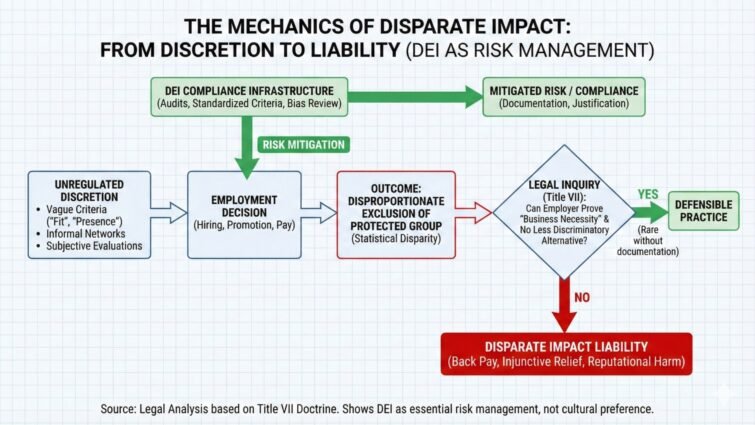
DEI did not arise as a social movement appendage to civil-rights law. In its modern institutional form, it arose as a response to enforcement. Many of the practices now labeled “DEI”—structured hiring criteria, expanded recruitment pipelines, pay-equity audits, bias training, internal reporting mechanisms, documentation protocols—were adopted after litigation, consent decrees, and regulatory guidance exposed how informal systems produced unlawful outcomes.
In other words, DEI became compliance infrastructure.
When institutions remove that infrastructure, they do not return to a neutral baseline. They revert to discretionary systems that Title VII has spent decades constraining. The rollback restores opacity, not merit.
Consider hiring.
When employers abandon structured evaluation rubrics in favor of “holistic” or “culture-fit” assessments, they increase exposure to disparate impact and disparate treatment claims. Subjective criteria are not unlawful per se, but they are difficult to defend when challenged. Without documentation, employers cannot explain why one candidate was selected over another using job-related criteria. The absence of explanation becomes evidence.
Consider promotion.
When advancement decisions are decentralized and undocumented, patterns emerge that are invisible internally but obvious externally. Homogeneity at senior levels does not need to be intentional to be unlawful. It needs only to be unjustified. DEI-driven promotion audits and succession planning exist to identify these patterns before they become claims. Their removal delays detection until litigation.
Consider compensation.
Pay-equity audits are often the first casualty of backlash politics. They are also among the most effective risk-management tools available. Without them, disparities accumulate silently. When exposed through litigation or agency investigation, employers face not only back pay but liquidated damages, injunctive relief, and reputational harm. The decision to stop measuring does not stop liability. It only ensures surprise.
Retaliation risk escalates most sharply after DEI rollbacks.
When reporting channels are narrowed or eliminated, employees do not stop experiencing discrimination. They stop reporting it internally. The first notice an employer receives is often an EEOC charge or a lawsuit. Retaliation claims follow because managers, untrained and unsupported, respond defensively when complaints surface externally.
This dynamic is not hypothetical. Retaliation remains the most frequently alleged basis of discrimination charges precisely because institutions underestimate how reporting systems function as shock absorbers. DEI critics often frame these systems as grievance factories. In reality, they prevent escalation.
The rollback of DEI training also carries consequences.
Training is frequently dismissed as symbolic or ideological. In litigation, it functions as evidence. Employers that can demonstrate good-faith efforts to educate managers on lawful decision-making are better positioned to defend against punitive damages and willfulness findings. Employers that cannot demonstrate such efforts face steeper exposure.
The law does not require perfection. It does require diligence.
Algorithmic decision-making magnifies these risks.
As employers rely more heavily on automated screening, scheduling, and evaluation tools, disparate impact risk increases. Algorithms trained on historical data reproduce historical bias unless corrected. DEI-related oversight—testing, auditing, vendor accountability—is often the only mechanism through which employers can demonstrate business necessity and lack of less-discriminatory alternatives.
Rolling back those safeguards while expanding automation is a litigation blueprint.
The backlash narrative often frames DEI as coercive or unnecessary in a “color-blind” era. That framing misunderstands how liability attaches. Title VII does not punish employers for acknowledging race or gender in compliance analysis. It punishes employers for maintaining unjustified practices that exclude protected groups.
Courts do not ask whether an employer intended to discriminate when assessing disparate impact. They ask whether the employer can justify its systems. DEI rollbacks make justification harder, not easier.
There is also a governance dimension to this exposure.
Boards and executives increasingly face scrutiny not only for discriminatory outcomes, but for failures of oversight. When internal compliance mechanisms are dismantled despite known risk, plaintiffs frame the decision as deliberate indifference. That framing raises the stakes. It shifts cases from negligence to willfulness. It invites broader remedies.
Public institutions face additional risk.
Government employers are subject not only to Title VII but to constitutional claims under equal protection and due process. DEI rollbacks in the public sector often remove guardrails that protected against arbitrary decision-making. The result is increased exposure to §1983 litigation, not reduced.
Universities face parallel risks under Title VI, Title IX, and state civil-rights laws. Admissions and employment decisions made without documented criteria invite challenge. The absence of process becomes the story.
The irony is that institutions often justify DEI rollbacks as necessary to avoid litigation. The effect is the opposite. By removing compliance infrastructure, they weaken defenses and strengthen claims.
This is not conjecture. It is the lesson of decades of civil-rights enforcement.
Compliance does not require ideological alignment. It requires systems that produce lawful outcomes. DEI, at its best, is not a statement of values. It is a method of risk control.
The backlash against DEI succeeds rhetorically because it frames compliance as preference and oversight as bias. It fails legally because the law remains indifferent to that framing. Courts and agencies ask different questions: Were decisions job-related? Were practices justified? Were disparities examined? Were complaints addressed?
Institutions that answer “no” to those questions do not benefit from cultural arguments. They face liability.
The deeper mistake underlying DEI rollbacks is the assumption that equality is discretionary. It is not. Equality under Title VII is a condition of operation. Employers may disagree with it politically, but they cannot opt out of it legally.
The final chapter returns to first principles. Equality under civil-rights law is not a moral aspiration or a cultural preference. It is a compliance obligation. Treating it as anything else produces precisely the instability the backlash claims to resist.
Equality Is Compliance, Not Cultural Preference
The claim that equality has gone too far survives only when law is replaced with feeling and data is displaced by grievance. When examined through statute, doctrine, labor-market outcomes, and enforcement reality, the narrative of “reverse discrimination” collapses under its own weight. It is not a description of how the law operates. It is a reaction to what the law requires.
Title VII has not changed its meaning. It has not reversed its orientation. It has not recalibrated its protections. For sixty years, it has done one thing consistently: constrained employment decision-making that relies on protected characteristics rather than job-related criteria. That constraint was disruptive when it dismantled overt exclusion. It remains disruptive as it exposes structural bias embedded in systems that once passed as neutral.
Disruption is not discrimination.
The backlash misidentifies the source of its discomfort. What has narrowed is not opportunity, but discretion. What has been constrained is not merit, but unexamined authority. When employers are required to justify hiring screens, promotion criteria, compensation structures, and algorithmic tools, the demand for explanation feels punitive to those accustomed to insulation. That feeling is then miscast as injury.
Civil-rights law does not recognize that injury.
The data makes this plain. White men remain advantaged across earnings, occupational concentration, job security, and advancement. No empirical record supports the claim that they have become structurally disadvantaged as a class. Black women, by contrast, continue to bear one of the most persistent economic penalties in the labor market—despite educational attainment, workforce participation, and decades of formal equality.
A system that produces that outcome has not reversed discrimination. It has failed to eliminate it.
Enforcement reality confirms this conclusion. The EEOC’s docket is not shaped by ideology. It reflects where harm occurs. Retaliation dominates because institutions still resist accountability. Systemic cases persist because discrimination operates through policy and practice, not confession. Emerging risks—algorithmic bias, pay opacity, informal promotion pipelines—are now central because discrimination has adapted, not disappeared.
If equality had overshot, enforcement would show it. It does not.
The backlash therefore operates in the space between perception and pattern. It relies on anecdote rather than aggregation. It substitutes expectation for evidence. It reframes competition as exclusion and oversight as bias. Those moves may succeed politically. They fail legally.
This failure has consequences.
Institutions that dismantle compliance infrastructure in response to backlash politics expose themselves to greater liability, not less. DEI rollbacks do not restore neutrality. They remove the very mechanisms that detect and prevent unlawful outcomes. The result is predictable: undocumented decisions, unexamined disparities, retaliation claims, and systemic exposure.
The law does not reward ignorance. It punishes it.
What this moment reveals is not that equality has become excessive, but that it has become enforceable. That shift—from aspiration to obligation—is what generates resistance. When equality is merely rhetorical, it is tolerated. When it is operationalized, it is contested.
That contest is not new. Every major expansion of civil-rights enforcement has produced claims of overreach. Each time, the claim has rested on the same assumption: that existing distributions of power and opportunity are neutral unless proven otherwise. Title VII rejects that assumption. It places the burden on institutions to justify exclusion, not on individuals to accept it.
Equality under the law is not a cultural preference. It is not a political project. It is a condition of lawful operation.
The fiction of “reverse discrimination” persists because it offers a way to resist that condition without engaging the statute, the data, or the doctrine. It allows institutions to frame accountability as unfairness and compliance as coercion. It provides cover for retreat.
But the law does not retreat with them.
As technology reshapes hiring, as labor markets tighten and loosen, and as enforcement adapts to new forms of bias, the core requirement remains unchanged: employment decisions must be lawful. Systems must be justified. Disparities must be examined. Retaliation must be prevented.
Those obligations are not ideological. They are statutory.
Equality feels like injury only when privilege depended on discretion the law no longer permits. That discomfort is real. It is not cognizable.
The future of civil-rights enforcement will not be determined by backlash narratives. It will be determined by whether institutions accept that equality is no longer a matter of intent or attitude, but of design and accountability.
The statute already answered the question. The data confirms it. Enforcement enforces it.
The rest is noise.
Reader Supplement
To support this analysis, I have added two companion resources below.
First, a Slide Deck that distills the core legal framework, case law, and institutional patterns discussed in this piece. It is designed for readers who prefer a structured, visual walkthrough of the argument and for those who wish to reference or share the material in presentations or discussion.
Second, a Deep-Dive Podcast that expands on the analysis in conversational form. The podcast explores the historical context, legal doctrine, and real-world consequences in greater depth, including areas that benefit from narrative explanation rather than footnotes.
These materials are intended to supplement—not replace—the written analysis. Each offers a different way to engage with the same underlying record, depending on how you prefer to read, listen, or review complex legal issues.