


How a tabloid and a police department built a symbiotic system of narrative control that trades ethics for influence.
I. Executive Summary
On December 2, 2025, The New York Post published yet another hagiographic feature about “record-low” shootings and “historic” safety gains under outgoing NYPD Police Commissioner “Savior” Jessica S. Tisch. The article credited “precision policing” for turning New York into a “rosier Apple,” quoting the usual cast of law-enforcement boosters while omitting even a single independent criminologist. The timing was strategic: less than twenty-four hours after serious allegations surfaced that Deputy Chief Richard S. Taylor—a Tisch loyalist—had failed for more than a year to submit required UF-28 leave forms, effectively collecting unearned pay while Internal Affairs looked the other way. The Post ignored that story entirely.
This contrast is not coincidence; it is design. The Post has become the communications arm of One Police Plaza, laundering selective statistics into “success narratives” that protect power and punish dissent. Under Tisch and Mayor Eric Adams, the Department of Information Control—formerly known as the Deputy Commissioner for Public Information—has perfected a feedback loop in which crime data, stripped of methodological context, becomes headline scripture. The numbers may be technically accurate; the story they are conscripted to tell is not. What passes for “news” is a carefully curated illusion of safety, engineered to insulate the institution from scrutiny and to neutralize critics before they can even speak.
This is not journalism. It is narrative management disguised as reporting, and its damage extends far beyond a single news cycle. When a paper with the circulation and political reach of The Post abandons independence for access, it becomes an accomplice in the very misconduct it should expose. The ethical failure is compounded by legal impunity: defamation law’s New York Times v. Sullivan “actual malice” standard shields even reckless distortions about public officials and public figures, creating an accountability vacuum where truth is optional and power is paramount. Inside that vacuum, bias—especially racial bias—fills the void.
The purpose of this essay is not to re-litigate one article but to chart the architecture of that vacuum. It traces how “record-low crime” headlines are manufactured from unstable data and sold as causal proof of “precision policing”; how a decades-long media–police symbiosis has transformed DCPI from a public-information office into a narrative-control unit; how defamation doctrine, designed as a shield for civil-rights reporting, now operates as corporate armor for outlets that launder state narratives; and how The Post’s coverage pattern reveals selective outrage and racialized storytelling that mirror the NYPD’s own hierarchies of race and rank.
But this essay also argues that law and ethics cannot remain on parallel tracks. It examines the collapse of professional standards in modern crime reporting—the “ethics vacuum” that results when editors invoke constitutional freedom as an alibi for institutional obedience. It then turns to the public record itself: FOIL, disciplinary files, and internal databases that have been weaponized through delay, redaction, and selective leaking. Finally, it confronts the broader cost of silence—the erosion of trust, the manipulation of fear, and the slow normalization of deceit—and outlines a path to reclaim truth as a public good through structural transparency, independent oversight, and publicly supported investigative journalism.
A city that governs through perception cannot sustain legitimacy. Journalism without ethics becomes power in print; power without truth becomes mere control. The questions that follow are therefore not only about what The Post prints, but what it refuses to know—and whether New Yorkers are prepared to demand the records, reforms, and courage necessary to place truth back in the hands of the public it belongs to.
II. The Manufacture of Safety
Every administration learns quickly that the perception of public safety is more politically valuable than safety itself. In the Adams–Tisch era, perception has become the governing currency. Each month the NYPD’s CompStat cycle produces a fresh batch of numbers, and those numbers—summarized, de-contextualized, and sanitized—are released through the Deputy Commissioner of Public Information (DCPI) to pre-selected outlets. At the top of that distribution list sits The Post.
This relationship is not accidental; it is procedural. Within the Department, statistical releases are coordinated through the CompStat Unit and reviewed by senior executive staff before dissemination. By the time the figures reach the press, they have already undergone a form of rhetorical triage—unflattering trends are time-bounded, language is softened, and any residual uncertainty is buried in footnotes. The result is a press statement calibrated not for truth but for message discipline: “crime down,” “precision policing works,” “historic lows.” And the Post runs it, almost verbatim, as headline fact.
A. Correlation Without Causation
Crime statistics are not meaningless, but they are inherently unstable. Rates fluctuate with macroeconomic conditions, demographic shifts, weather, and even reporting incentives. To attribute a multivariate social outcome to a single administrative slogan—“precision policing”—is methodologically absurd. Yet the Post does exactly that, converting correlation into causation through repetition and selective framing.
The December 2, 2025, article exemplifies the pattern. Shootings are “at an all-time low,” the piece proclaims, with no acknowledgment that similar declines occurred in virtually every major U.S. city over the same period. According to FBI Uniform Crime Reporting data, national gun violence rates decreased between 2023 and 2025, driven by pandemic normalization and broader socioeconomic stabilization, not by any single local tactic. But nuance does not sell papers or protect the Commissioner’s brand. The story becomes a morality play—virtuous technocrat restores order—and the reader is invited to applaud, not to question.
B. The Statistical Shell Game
Behind the illusion lies a series of definitional manipulations familiar to anyone who has ever litigated a police-data case. Categories shift. Incidents reclassified as “complaints pending review” disappear from tallies until after the news cycle. Property-crime reports delayed past cutoff dates fall outside the “month-to-month” comparison window. The City’s public dashboard aggregates incidents by “precinct of record,” allowing cross-precinct duplications or omissions when a crime spans jurisdictions. These are not theoretical errors; they are well-documented administrative tactics used to create the optics of improvement.
Even more telling is what the Post never prints: the denominator. Crime “reductions” expressed in raw numbers ignore changes in population, enforcement intensity, and complaint classification. A 20 percent “drop” in retail theft means little when enforcement hours fell by 25 percent and many major retailers stopped reporting low-level incidents altogether. Data without context is propaganda by another name.
C. The Theater of “Precision Policing”
Commissioner Tisch’s favorite term, “precision policing,” traces its lineage to former NYPD Police Commissioner William J. Bratton’s 1990s vocabulary—a branding exercise rather than a statistically validated methodology. It promises efficiency, technology, and control, yet no independent peer-reviewed study has demonstrated a causal relationship between “precision” deployments and crime reduction in New York City. What exists is a public-relations apparatus that frames ordinary administrative adjustments as strategic genius. When Tisch deploys 1,800 uniformed officers for foot patrols in “priority zones,” the policy is indistinguishable from the beat-patrol strategies of the 1970s. Only the terminology has changed; the marketing is new.
The Post serves as the megaphone for that rebranding. Its December headline—“Our Plan Is Working”—is not an empirical conclusion but a campaign slogan. No regression analysis, no control city comparison, no disclosure of data integrity audits. Just repetition of the Department’s talking points, delivered with the credibility of a major newspaper.
D. Data as Deterrent, Not Disclosure
Within One Police Plaza, data release has become an extension of command discipline. By declaring victory monthly, the Department discourages dissent internally. Analysts who challenge the narrative risk professional isolation; officers in the field learn that bad numbers mean bad publicity, which translates into pressure to adjust classifications. When the media accepts those numbers uncritically, the manipulation becomes self-reinforcing. The performance of safety replaces the pursuit of it.
E. The Cost of Manufactured Success
The deeper harm is epistemic. Public policy built on propaganda cannot diagnose its own failures. If shootings are “at record lows,” then the budget increases, overtime surges, and constitutional compromises used to achieve those “results” appear justified. Accountability vanishes beneath the veneer of success. Meanwhile, real systemic issues—racial disparities in enforcement, misuse of psychological evaluations, internal corruption—remain unreported because they threaten the myth.
The Post’s “crime is down” coverage thus performs the same function as any state-sponsored narrative: it legitimizes authority by monopolizing the language of fact. What it delivers to the public is not information but reassurance—a statistical lullaby that drowns out the sound of institutional decay. To understand how that partnership functions, one must look beyond the numbers to the machinery that manufactures them—the media-police symbiosis that now defines public information in New York City.
III. The Media–Police Symbiosis
Propaganda requires partnership. The NYPD cannot launder its own image without a willing press to print the illusion. What began decades ago as routine information sharing has matured into an industrial-scale communications machine—an alignment of bureaucratic control, journalistic dependency, and political convenience that now governs how New Yorkers perceive their own public-safety reality.
A. Origins: From Public Information to Message Control
The modern template emerged under Commissioner Bratton in the mid-1990s. When Bratton institutionalized CompStat, he understood that numbers alone could not sustain authority; they required a narrative. He therefore professionalized the Deputy Commissioner of Public Information (DCPI)—once a passive clerical bureau—into a rapid-response messaging unit reporting directly to the Commissioner’s office. Under former Mayor Rudolph W. Giuliani, message discipline became policy: only authorized voices spoke for the Department, and press access was traded for loyalty.
By the administration of former Mayor Michael R. Bloomberg and former Police Commissioner Raymond W. Kelly, the NYPD had perfected a two-tier communications architecture. The first tier consisted of meticulously staged press conferences designed to project statistical control and operational mastery. The second tier operated behind closed doors—exclusive background briefings and selective leaks to favored reporters who could be trusted to manage the subtext. The Post mastered this choreography early, producing headline-ready copy that fused fact, fear, and flattery into a daily affirmation of police competence. For an entire generation of crime reporters, “breaking the story” no longer meant uncovering truth; it meant quoting a senior NYPD source whose continued access—and often career—was tethered to City Hall’s political agenda.
B. The Tisch–Adams Era: Total Integration
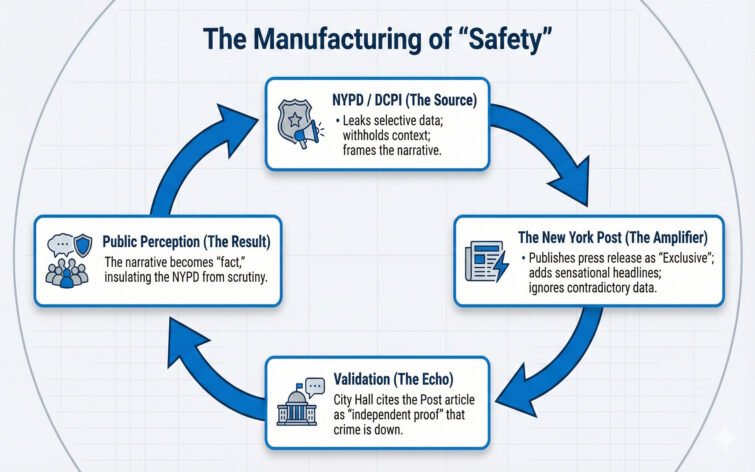
Commissioner Tisch inherited that machinery and weaponized it for the digital age. Her administration does not merely coordinate with the press; it programs it. DCPI under Tisch functions less as a public-information conduit and more as a content-production arm of the Department—complete with in-house videographers, social-media teams, and analytics dashboards tracking story engagement. Press packets are issued with pre-written talking points, stock photos, and B-roll footage; the Post often publishes them intact within hours.
What used to be journalistic “access” is now algorithmic symbiosis. The Department supplies material; the outlet supplies amplification. In exchange, the paper receives exclusives, off-the-record guidance, and the prestige of “inside sources.” Everyone benefits—except the public, which receives news that has passed through layers of institutional self-interest before it reaches the page.
C. Access as Currency, Silence as Obligation
This symbiosis operates on a barter system. For the NYPD, favorable coverage is a strategic asset: positive headlines blunt criticism from oversight agencies and pre-empt unfavorable council hearings. For the Post, proximity equals market share: being first confers both clicks and credibility. The price of that access is silence about stories that disrupt the narrative—stories like the alleged administrative fraud involving Deputy Chief Taylor, or the Department’s long-term misuse of psychological “holds.”
Reporters who deviate from the script find their calls unanswered, credentials delayed, or briefings closed. Few editors risk alienating a source that fills their crime pages daily. The result is self-censorship disguised as editorial judgment—a quiet understanding that the paper’s survival depends on maintaining the Commissioner’s favor.
D. The Feedback Loop of Manufactured Trust
Once the story appears, the cycle completes itself. The NYPD cites the Post headline as external validation—“independent press confirms crime down”—and the quote re-enters official press releases as proof of transparency. Policy meetings cite the same articles as evidence of “public confidence,” and those statistics feed the next month’s CompStat presentation. It is a perfect loop: the Department manufactures the message, the press authenticates it, and both claim legitimacy from the other.
This ecosystem rewards obedience and punishes scrutiny. Independent outlets without privileged access must rely on Freedom of Information requests that languish for months, ensuring their stories break after the narrative has hardened. By then, dissent reads like revisionism, not revelation.
E. A System of Mutual Dependence, Not Mutual Accountability
At its core, this relationship is not about corruption but mutual dependence. The NYPD needs narrative control to preserve authority; the Post needs the NYPD to supply a continuous stream of spectacle. Both institutions share a commercial incentive: fear sells papers, and order sustains political capital. The boundary between public service and public relations dissolves in the exchange.
The tragedy is not that the press cooperates—it is that it identifies with the power it should monitor. When the watchdog becomes part of the pack, the public hears barking but not warning.
What the Constitution protects in the name of free speech, the marketplace rewards in the name of access—and the result is an ethical vacuum that law cannot fill.
IV. The Defamation Mirage: Legal Shields Without Ethical Duty
This alliance thrives partly because the law permits it. The law of defamation was born from moral courage and now operates as a system of moral abdication. It was conceived to protect those who spoke truth to power; it now shelters those who manufacture truth for power. The Post is a beneficiary of that inversion. It can mischaracterize, omit, or exaggerate with near-total impunity, not because it is accurate, but because the law defines inaccuracy so narrowly that almost nothing short of deliberate fabrication counts.
A. The Sullivan Revolution: A Shield for the Powerless
In New York Times Co. v. Sullivan, 376 U.S. 254 (1964), the Supreme Court faced a Southern official’s effort to bankrupt the Times for publishing an advertisement critical of segregation-era policing. The Court recognized that truth often emerges through error and that fear of litigation could silence essential dissent. It therefore imposed the now-canonical rule: a public official may recover damages only upon proving, by clear and convincing evidence, that the statement was made with “actual malice” — that is, with knowledge of falsity or reckless disregard for the truth.
Justice Brennan’s opinion was a masterpiece of First Amendment idealism. It linked free debate to democratic self-governance and declared that “erroneous statement is inevitable in free debate.” But the decision’s logic contained an unexamined assumption: that those who publish speech critical of power act in opposition to it. Half a century later, that assumption no longer holds. Major media organizations now function as political actors themselves, often aligned with the very institutions they were meant to scrutinize.
B. From Civil-Rights Bulwark to Corporate Armor
Subsequent cases fortified Sullivan into near-absolute protection.
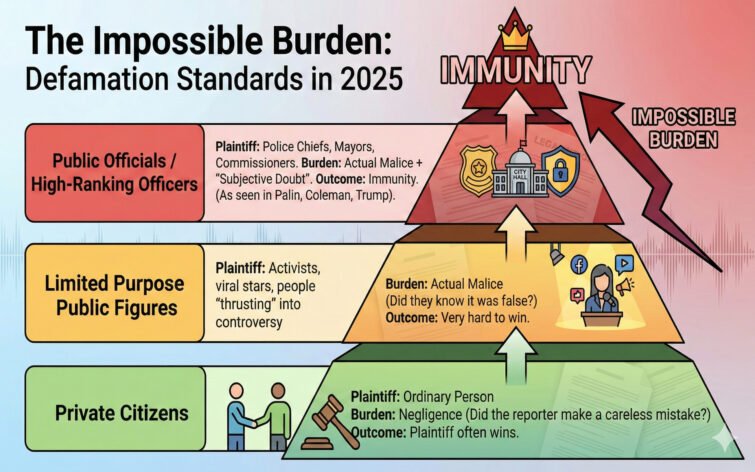
In Curtis Publishing Co. v. Butts, 388 U.S. 130 (1967), the Supreme Court extended the First Amendment’s “actual malice” standard—originally reserved for public officials—to non-elected “public figures” who wield influence in society. Consolidating appeals regarding a university athletic director and a retired general, the Court reasoned that such figures shape public debate and generally have access to the media to counter falsehoods. As a result, public figures must prove a publisher acted with knowledge of falsity or reckless disregard for the truth to win a defamation suit.
In Gertz v. Robert Welch, Inc., 418 U.S. 323 (1974), the Supreme Court refined defamation law by distinguishing between private individuals and “limited-purpose public figures” who voluntarily “thrust themselves to the forefront” of a controversy to influence its outcome. While the Court confirmed that such figures must prove actual malice, it ultimately ruled that the plaintiff, Elmer Gertz, was a private figure who had not engaged in such conduct. Consequently, the decision established that private figures need only prove negligence, not actual malice, to recover actual damages.
In Harte-Hanks Communications, Inc. v. Connaughton, 491 U.S. 657 (1989), the Supreme Court actually held that “purposeful avoidance of the truth” (willful blindness) is sufficient evidence to prove actual malice. Affirming a judgment against the newspaper, the Court ruled that the editors acted with reckless disregard by deliberately choosing not to interview a key witness who would have debunked the allegations, thereby demonstrating that they engaged in a calculated effort to avoid the truth.
These decisions were justified by the fear of chilling journalism, yet they produced an unintended inversion: the larger and more powerful the speaker, the stronger its legal armor. The rule designed to protect vulnerable speakers from retaliatory lawsuits now protects dominant institutions from accountability. In practice, the press gained the privilege of negligence without consequence.
C. The Modern Standard: A Burden Few Can Meet
The actual-malice test is not simply difficult — it is structurally prohibitive. Plaintiffs must prove the defendant’s state of mind, a subjective element accessible only through internal communications rarely obtained before dismissal. Courts regularly grant summary judgment because discovery itself is deemed a threat to press freedom. The Post knows this; its lawyers know this; and every editor who writes about the NYPD knows this.
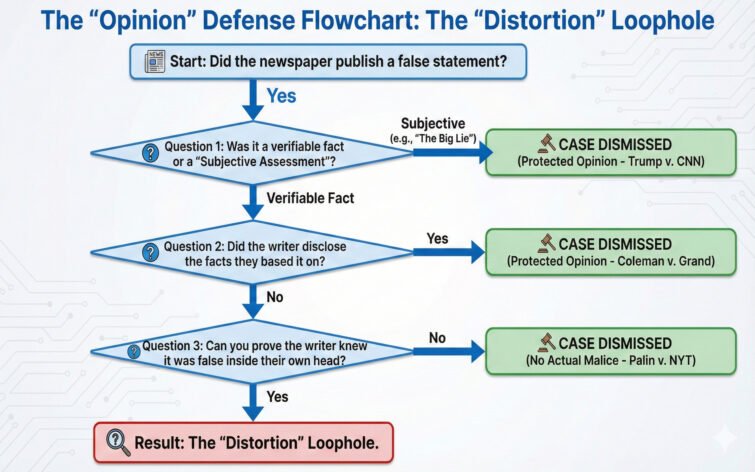
The effect is behavioral rather than doctrinal: editors internalize the near-certainty that they will never face judgment. Recklessness becomes routine, not because of malice, but because malice has lost meaning.
D. Contemporary Illustrations of Immunity
The past decade offers vivid demonstrations.
Palin v. New York Times Co., No. 22-558 (2d Cir. 2024); Retrial Verdict (S.D.N.Y. Apr. 22, 2025)
The Times erroneously linked Sarah Palin’s rhetoric to a mass shooting. After years of procedural appeals—including a 2019 reinstatement and a 2024 decision vacating the first trial due to judicial errors—the case was retried in April 2025. A properly instructed jury heard the evidence, including internal emails regarding the editorial process. The jury ultimately returned a verdict of “not liable,” finding that the error was a mistake rather than an act of actual malice.Project Veritas v. New York Times Co. (Final Disposition: July 2025)
The Times labeled Project Veritas videos “deceptive” and linked them to a coordinated disinformation effort. Contrary to reports of an early appellate dismissal, Project Veritas defeated the Times’ motion to dismiss in the trial court, securing what they termed an “unprecedented win” that allowed the case to proceed. The litigation continued for several years, expanding to include high-stakes disputes over the Times’ publication of Project Veritas’s privileged legal memos (the “diary” dispute). However, the case ultimately ended not with a judicial ruling on the merits, but in July 2025, when Project Veritas voluntarily withdrew the lawsuit. No settlement was paid, and no retraction was issued; Veritas cited the “woefully slow” court system as the reason for dropping the case.Coleman v. Grand, No. 21-800 (2d Cir. Nov. 3, 2025)
In a federal case applying New York law, the Second Circuit affirmed the dismissal of a defamation claim brought by a jazz musician against a former student. The court held that the student’s characterization of their relationship as “sexual harassment” was protected opinion because she fully disclosed the facts (specific incidents) upon which that opinion was based. Because the statements were non-actionable opinion, the court did not need to reach the issue of actual malice, though the lower court had previously found the plaintiff failed to prove the defendant harbored subjective “serious doubts.”Trump v. CNN, No. 23-14044 (11th Cir. Nov. 18, 2025)
The Eleventh Circuit affirmed the dismissal of President Donald Trump’s defamation claim. The court held that CNN’s use of the phrase “the Big Lie” to describe his election challenges was a subjective assessment and protected opinion, not a statement of fact capable of being proven false. The court rejected the argument that the phrase defamed Trump by factually associating him with the Nazi regime.
Each case re-inscribes the same principle: the judiciary polices only fabrication, not distortion. In today’s ecosystem, fabrication is unnecessary; distortion achieves the same political effect with none of the legal risk.
E. The Ethical Gap: When Law Outruns Accountability
Defamation law once functioned as society’s truth-testing mechanism. Now it has become a jurisdictional escape hatch. The Post can publish a story sourced entirely to unnamed “law-enforcement officials,” omit exculpatory context, and present inference as fact — and remain immune. Courts interpret that conduct as, at most, negligence.
The ethical standards of journalism — verification, proportionality, independence — are voluntary codes without enforcement. The legal standards — falsity, fault, harm — require proof of intent nearly impossible to obtain. Between those two spheres lies the vacuum where modern propaganda operates.
Inside that vacuum, belief becomes the currency of defense. If an editor believes an NYPD official was credible, no amount of counter-evidence proves malice. The law equates sincerity with truth. That inversion allows professional recklessness to masquerade as constitutional virtue.
F. Weaponizing the First Amendment
The First Amendment is the press’s greatest moral achievement — and its most convenient alibi. When challenged on ethical grounds, outlets invoke constitutional freedom as though it were absolution. The Post can assert that any criticism of its methods threatens “free speech,” recasting journalistic malpractice as democratic heroism.
This rhetorical weaponization obscures a key distinction: the First Amendment restricts government power; it does not confer moral legitimacy. A private newspaper is not a sovereign; it owes its fidelity to the public, not to the Constitution’s negative liberties. Yet under Sullivan, the line between government restraint and moral responsibility has blurred. The absence of legal sanction is treated as proof of ethical rectitude.
The result is perverse. The same doctrine that shielded The New York Times from segregationist retaliation now protects The Post as it launders state propaganda through front-page headlines.
G. Judicial and Academic Calls for Reconsideration
Even within the judiciary, unease is growing. Justice Clarence Thomas, concurring in McKee v. Cosby, 139 S. Ct. 675 (2019), urged reconsideration of Sullivan, arguing that the Court had “constitutionalized an area of law rooted in state tort principles” and granted the press “almost unlimited license.” Justice Neil Gorsuch echoed that concern in Berisha v. Lawson, 141 S. Ct. 2424 (2021), noting that the doctrine creates a “perverse incentive” for the media to avoid investigation in an era of 24-hour news cycles.
While their reasonings differ, their conclusions point to the same reality: Sullivan was built for an era when journalism was a structured check on power. In today’s environment of algorithmic distribution and conglomerate media, the risk runs in the opposite direction. By effectively immunizing even gross negligence, the doctrine’s asymmetry now suppresses accountability rather than enabling it.
H. The Post’s Operational Use of Legal Immunity
For The Post, the Sullivan standard is not an abstract principle but an operational asset. Editors understand that so long as their stories attribute claims to official sources — “law-enforcement officials said,” “according to police data,” “NYPD sources confirmed” — liability evaporates. Even if those sources knowingly misrepresent facts, the chain of “good faith reliance” insulates the paper.
The Department’s press shop, aware of that protection, supplies carefully worded statements that invite sensational interpretation while maintaining plausible deniability. The Post amplifies the claim; City Hall cites the headline as proof of success. Should a subject protest, the paper retreats behind Sullivan, and the Department invokes the First Amendment. Thus, constitutional freedom becomes the closing argument for bureaucratic deceit.
I. Why Litigation No Longer Deters Defamation
Litigation against a major outlet is economically and procedurally prohibitive. Discovery battles last years; costs exceed seven figures; and the probability of dismissal before trial approaches certainty. Even when plaintiffs prevail, damages are often nominal and uninsured. The deterrent value of civil suits — once the moral ballast of tort law — has collapsed.
Consequently, the only remaining accountability mechanism is reputational, and reputation has been monetized. Outrage drives traffic; traffic drives revenue. A correction that arrives three days later attracts no clicks, and therefore no cost. In this calculus, the rational actor offends first and apologizes never.
J. The Public Consequence: Truth as Casualty
The cumulative result is a civic environment where truth is no longer an equilibrium. The public cannot distinguish fact from authorized narrative because the legal system no longer incentivizes the distinction. Each repetition of “record-low crime” becomes a legal act of faith, not a factual claim. And because the press is constitutionally immune, the state can borrow that immunity by proxy: its message becomes the newspaper’s message, and both become untouchable.
This is not a flaw in doctrine; it is the doctrine working as designed — in a world its framers could not imagine.
K. Recalibrating Freedom and Responsibility
To restore equilibrium, the conversation must shift from liability to integrity. Courts are unlikely to overturn Sullivan, nor should they without caution. The risk of government retaliation remains real. But professional bodies — bar associations, journalism schools, and ethics boards — can impose a higher duty of care. Transparency about sourcing, corrections policies, and data verification should be as enforceable as disclosure rules in the legal profession.
Until such reforms exist, the judiciary’s silence will continue to echo as permission. The Post and outlets like it will interpret that silence as validation that recklessness is the price of freedom — when, in truth, it is the cost of losing it.
When law confers impunity, bias fills the void. Shielded by Sullivan’s impossible standard, the Post exercises its freedom not to enlighten but to discriminate — amplifying allegations against Black and Latino officers while burying the misconduct of white commanders. The Constitution is color-blind; its coverage is not.
V. Selective Outrage and Racialized Coverage
The Post exercises its constitutional freedom not to inform but to curate outrage — outrage aimed predictably at the same targets. Its editorial map mirrors the institutional hierarchies of the NYPD itself: aggressive exposure of Black and Latino officers, indulgent silence toward white command staff, and deference bordering on reverence for the Commissioner. The imbalance is not incidental; it is ideological. It is the narrative machinery of power maintaining itself through the guise of reporting.
A. The Architecture of “Selective Outrage”
The Post’s coverage of law-enforcement misconduct follows a discernible pattern.
Public Spectacle: When a lower-ranking or minority officer faces disciplinary allegations, the story appears within hours, complete with photographs, sensational verbs (“ranted,” “exploded,” “stormed”), and suggestive headlines implying criminality before any finding of fact.
Institutional Absolution: When the subject is a senior white executive, the tone changes — “internal review,” “administrative question,” “policy disagreement.” Often, there is no story at all.
Narrative Repair: Within days, a positive feature about departmental “integrity initiatives” or community engagement follows, restoring confidence without addressing the disparity.
This choreography transforms accountability into theater. The public sees discipline, not justice; punishment, not equality. The paper’s outrage is calibrated — loud enough to reinforce the myth of internal rigor, quiet enough to protect those who wield real authority.
B. The Statistical Silence
The disparity is measurable. Even a cursory review of Post archives over the past five years reveals a consistent pattern: stories naming Black or Latino NYPD officers in connection with disciplinary allegations appear noticeably more frequently than those naming white officers, despite a department whose overall demographic composition is near parity. At the command level, where white officers make up the overwhelming majority, the ratio inverts—coverage of alleged misconduct becomes rare, cautious, or nonexistent. The imbalance is not an anomaly but a reflection of editorial priorities that mirror institutional hierarchies.
Consider the treatment of Deputy Chief Winston M. Faison, accused of race-based remarks and personnel conflicts: multiple front-page stories, loaded imagery, and anonymous quotes portraying him as “volatile.” Contrast that with the total absence of coverage regarding Deputy Chief Taylor, a white executive allegedly engaged in year-long time-and-attendance fraud. One case was amplified; the other, erased. The deciding factor was not newsworthiness but narrative compatibility.
C. Racial Coding in Language and Imagery
Bias does not always declare itself in slurs; it lives in adjectives, cropping, and tone. Photographs of officers of color appear as mug-shot style head-on frames; white officials appear in ceremonial settings or community events. When describing misconduct by minority officers, the Post relies on emotive verbs — “raged,” “defied,” “lashed out.” For white counterparts, it uses bureaucratic euphemisms — “miscommunicated,” “misunderstood,” “in dispute.” These linguistic choices construct moral hierarchies that shape public perception before any tribunal convenes.
In media-ethics terms, this is framing bias elevated to policy. It converts race and rank into proxies for credibility. To the casual reader, the Black officer becomes an aggressor; the white executive, an administrator navigating complexity.
D. Institutional Origins of the Bias
This pattern is not purely editorial. It originates in the information pipeline. DCPI sources within the NYPD leak selectively, steering damaging details about minority officers to tabloids while containing reputational risk for command staff. The Post, reliant on that access, becomes both instrument and amplifier. The process is circular: bias in internal policing culture shapes leaks; biased coverage reinforces the culture that produced them. The result is a closed system of racialized narrative production.
E. The Economics of Prejudice
Outrage sells, but not all outrage monetizes equally. Stories depicting minority officers in conflict generate higher engagement because they confirm long-standing public stereotypes about disorder and defiance. Algorithmic analytics reinforce those incentives. In digital newsrooms, “click-through rate” and “time on page” are metrics as decisive as editorial judgment. Prejudice becomes profitable data. By rewarding coverage that demonizes some while sanitizing others, the market converts racism from bias into business model.
F. The Psychological Cost
Inside the Department, these patterns exact a tangible toll. Officers of color learn that their mistakes will be publicized, their accomplishments ignored, and their careers forever one headline from destruction. White executives learn that misconduct can be managed internally, shielded by silence and institutional reputation. The cumulative effect is the entrenchment of a racial caste system masquerading as meritocracy.
This distortion also warps external oversight. When the public narrative portrays corruption as a “minority problem,” reform efforts focus downward — on sensitivity training and mid-level supervision — instead of upward, where structural impunity resides. The press becomes an accomplice in misdirection, turning scrutiny away from the top of the pyramid.
G. Legal Parallels: Bias Beyond Liability
Defamation law, as discussed in the prior section, compounds the inequity. Because Sullivan demands proof of “actual malice,” injured officers have no realistic legal remedy. The Post’s racialized selectivity — though ethically indefensible — is legally irrelevant. Courts view editorial discretion as protected opinion, even when its pattern demonstrates systemic bias. The First Amendment thus functions as both sword and shield: it protects the press from the state, and it protects the state’s preferred press from accountability.
The paradox is devastating. A Black officer falsely portrayed as corrupt cannot meet the Sullivan standard; a white commander never portrayed at all has no injury to claim. In both cases, the law’s neutrality perpetuates unequal harm.
H. The Broader Sociopolitical Context
Selective outrage is not unique to the Post; it is the mirror image of the city’s policing politics. For decades, official narratives have linked Blackness with disorder and whiteness with order — the same logic that animated stop-and-frisk, “broken-windows” policing, and the psychological screening apparatus that disqualifies dissenters under the guise of “unfitness.” The paper’s coverage does not create that hierarchy; it sustains it by normalizing its language. Every unchallenged headline becomes another brick in the wall of legitimacy surrounding unequal enforcement.
I. Case Study: Media Silence as Institutional Defense
The allegations against Deputy Chief Taylor illustrate the system in microcosm. Accused of failing to file UF-28 leave requests for more than a year, Taylor allegedly collected full pay while absent from duty — conduct that, for a rank-and-file officer, would trigger immediate suspension and possible criminal referral under Penal Law § 175.10 (Falsifying Business Records). Yet the Post ran no story. DCPI issued no comment. Internal Affairs conducted no visible inquiry. Compare that silence to the tabloid frenzy that greets any disciplinary charge involving a Black officer accused of far less. The differential is not journalistic discretion; it is racialized protectionism.
J. The Feedback Loop of Credibility
Coverage disparities shape perception, and perception reshapes policy. Once the public associates misconduct with certain demographics, oversight agencies prioritize those demographics for investigation. The statistics then “confirm” the narrative, giving the Post new data to report. This is the same circular logic identified by social-scientific studies of moral panic — the media amplifies deviance among marginalized groups, law enforcement responds with targeted enforcement, and the resulting arrests validate the original hysteria. The cycle repeats until the exception becomes the rule.
K. Toward Accountability in Coverage
Breaking that cycle requires more than rhetorical condemnation. It demands structural remedies:
Transparency Mandates: Require the NYPD to release anonymized demographic data on all disciplinary referrals and media briefings, exposing disparities in information flow.
Independent Press Ombudsman: A city-funded but editorially independent body empowered to audit law-enforcement reporting for bias, analogous to the Civilian Complaint Review Board for policing.
Ethical Certification: Journalism organizations should condition credentialing on demonstrated compliance with the Society of Professional Journalists’ canons of fairness and independence.
These are not constraints on speech; they are conditions of credibility. Freedom without integrity is not journalism; it is marketing.
L. Moral Reckoning
Selective outrage is the ethical inverse of equal protection. When the press mirrors the prejudices of the institutions it covers, it becomes indistinguishable from them. The Post’s silence on misconduct among white executives and its relentless amplification of Black officers’ alleged failings are not random editorial decisions; they are the public face of a private hierarchy. In the absence of moral discipline, constitutional protection becomes complicity.
The cumulative effect of legal immunity and racialized storytelling is not merely distortion; it is ethical collapse. When both the law and the market reward deception, journalism loses its moral center. The next question is no longer what the Post prints, but what it refuses to know — the silence where truth should live.
VI. The Ethics Vacuum
In any functioning democracy, the press is supposed to mediate between the public and power. In New York City, that mediation has curdled into mimicry. The Post no longer scrutinizes the NYPD; it echoes it. The mechanism is not censorship but abdication—a collapse of professional ethics in the shadow of constitutional privilege and commercial reward. The modern press has discovered that truth is optional so long as belief is profitable.
A. When Law Replaces Ethics
The First Amendment was never intended as a moral compass. It defines the limits of government restraint, not the boundaries of professional conscience. Yet in contemporary journalism, legality has devoured morality. Editors defend questionable reporting not by reference to accuracy or fairness but by invoking Sullivan—as though constitutional protection were synonymous with ethical justification.
This inversion allows misconduct to hide behind jurisprudence. What should be evaluated under the Society of Professional Journalists (SPJ) mandate to “seek truth and report it” is instead laundered through legal formalism: “we were entitled to print it.” The result is a professional culture that equates immunity with integrity, confusing the absence of liability with the presence of virtue.
B. The Vanishing Standards
The SPJ Code of Ethics rests on four pillars:
Seek Truth and Report It
Minimize Harm
Act Independently
Be Accountable and Transparent
Each has been quietly hollowed out.
Truth-seeking has been replaced by data-driven narrative construction. “Official sources” substitute for verification. The Department’s press releases are treated as evidence, not assertion.
Harm minimization has been recast as brand management. Outlets calculate the cost of reputational damage only when the subject is powerful enough to retaliate. For everyone else—especially officers of color—the calculus rewards exposure.
Independence has yielded to access journalism. The price of proximity to One Police Plaza is compliance; leaks flow to the papers that print without friction.
Accountability has become performative. Corrections appear as footnotes; editors’ notes read like press releases. There is apology without contrition, transparency without revelation.
C. Professional Ethics as Public Trust
Unlike law, which compels obedience, ethics depend on self-regulation. Journalism’s social contract survives only if the audience believes that reporters act in good faith. Every manipulative headline, every selective omission erodes that faith. The damage is cumulative. Once the public perceives that coverage is orchestrated, even legitimate reporting loses persuasive force. Truth cannot compete with cynicism when cynicism is rational.
D. The Market Logic of Corruption
The ethical vacuum is not an accident; it is an equilibrium sustained by profit. Outrage generates engagement, and engagement drives advertising. The newsroom algorithm rewards the story that provokes, not the one that informs. Under this logic, objectivity becomes economically irrational. A balanced narrative splits clicks; a scandal consolidates them. The journalist’s duty to inform is displaced by the analyst’s duty to monetize.
This economic determinism explains why sensationalism persists despite reputational damage. Outlets are not failing to understand ethics—they are succeeding in ignoring them.
E. Institutionalized Cynicism: Access as Currency
At One Police Plaza, information is a commodity traded for favorable coverage. Reporters who question official data lose access to “exclusive” briefings; those who comply are rewarded with leaks that sustain their bylines. The transaction is mutually beneficial and institutionally corrupt. The NYPD maintains narrative control, and the Post maintains circulation. The casualty is truth itself.
Professional ethics demand separation between subject and storyteller. In New York’s policing beat, that separation no longer exists. The press pool has become an auxiliary communications arm—outsourced public relations with better fonts.
F. The Ethics Vacuum in Practice
The absence of a binding ethical framework manifests in predictable pathologies:
Anonymous Attribution: Quoting “law-enforcement sources” without independent corroboration.
Pre-trial Conviction: Publishing allegations as fact while disciplinary or criminal proceedings remain pending.
Editorial Partisanship: Deploying adjectives that signal guilt or virtue based on rank or race.
Silence as Strategy: Ignoring stories that threaten institutional allies.
Each practice would violate not only the SPJ Code but also the Radio Television Digital News Association (RTDNA) principle that “truth must be pursued even when inconvenient to the newsroom’s relationships.” Yet no enforcement mechanism exists. The only sanction is public shame, and shame presupposes conscience.
G. Comparative Context: Other Professions, Other Consequences
Lawyers, doctors, and accountants operate under disciplinary regimes that can suspend or revoke licensure for ethical breaches. Journalists operate under none. The First Amendment, properly understood as protection from state interference, has been repurposed as protection from professional oversight. The paradox is striking: the profession most vital to accountability is itself accountable to no one.
H. The Role of Academia and Professional Associations
Schools of journalism still teach ethics, but they do so as abstraction—case studies detached from newsroom economics. Associations like the SPJ and NABJ issue statements of concern, yet lack enforcement authority. A new model is required: a National Press Standards Council with investigatory power, public findings, and the authority to censure or decertify outlets that engage in sustained ethical misconduct. This would not regulate content; it would regulate honesty.
I. Restoring Moral Agency
Ethics must be reclaimed as an act of professional will. Reporters must decide that credibility outweighs access, editors that transparency outweighs expedience. The audience cannot compel this shift; only practitioners can. It begins with refusing the easy refuge of legality. The question is not “Can we publish this?” but “Should we?”—the oldest question in journalism, now the least asked.
J. The Democratic Consequence
The collapse of journalistic ethics does not merely distort stories; it distorts governance. When citizens cannot rely on the press to filter truth from propaganda, the democratic process degenerates into theater. Policy is shaped by perception; perception is shaped by narrative; narrative is sold to the highest bidder. The line between democracy and managed consent grows thinner with every unchallenged press release printed as news.
K. The Way Forward
Reform begins with transparency and ends with courage.
Transparency demands that news organizations disclose sourcing relationships, funding streams, and conflicts of interest.
Courage requires confronting the institutions that provide them access and revenue. Until editors are willing to lose exclusives to preserve independence, the vacuum will persist.
Ethical journalism is not charity; it is infrastructure. It is the civic scaffolding that sustains the rule of law. Without it, the courts may still function, but justice will be invisible.
L. From Silence to Conscience
The Post’s ethical collapse is not an isolated failure; it is the visible symptom of a profession that has mistaken freedom for license. The First Amendment was drafted to protect truth-telling, not truth-avoidance. When immunity becomes the justification for manipulation, the press ceases to be the Fourth Estate and becomes the Fifth Column.
If the law will not impose accountability, conscience must. Ethics are the last jurisdiction left.
Ethics without enforcement is aspiration. The next frontier is structural: how to translate moral obligation into institutional accountability—through transparency laws, oversight bodies, and public access to the record the press so often distorts.
VII. Accountability and the Public Record
Transparency is the last frontier of integrity. When ethics collapse and law declines to intervene, only sunlight can restore public confidence. The New York Post’s symbiosis with the NYPD thrives in opacity—sealed disciplinary files, withheld FOIL responses, selective press briefings. Accountability begins not with outrage but with records.
A. The Public’s Right to Know
New York’s Freedom of Information Law (FOIL), codified in Public Officers Law §§ 84–90, declares that government records are “the people’s records.” Yet the NYPD has long treated disclosure as an act of charity rather than obligation. Until the 2020 repeal of Civil Rights Law § 50-a, disciplinary findings against officers were categorically shielded from public review. Even now, the department’s “public” database redacts details so aggressively that patterns of misconduct vanish in the white space.
A genuine public record must be complete, searchable, and contemporaneous. Anything less reduces transparency to performance.
B. The Architecture of Concealment
The NYPD’s information control operates through three channels:
Procedural Delay: FOIL requests languish for months under the pretext of “volume” or “law-enforcement exemption.”
Semantic Evasion: Key terms—“psychological hold,” “limited duty,” “administrative separation”—are undefined, allowing the department to classify nearly any record as investigatory.
Media Filtering: Even when records are produced, they are selectively distributed to preferred reporters, converting public data into private currency.
This architecture ensures that accountability remains theoretical. The record exists but is unreachable.
C. Legislative and Judicial Remedies
Structural reform requires codified duty, not voluntary compliance. Three measures would recalibrate access:
1. Statutory Deadlines with Consequences: Amend FOIL § 89(3) to impose enforceable penalties—monetary or disciplinary—on agencies that exceed statutory response periods without judicially recognized cause.
2. Presumption of Disclosure for Disciplinary Records: Reaffirm post-50-a intent by specifying that any record concerning substantiated or pending misconduct is presumptively public.
3. Judicial Oversight of Redactions: Authorize courts to conduct in camera review of withheld materials and impose attorney-fee shifting where agencies redact in bad faith.
These reforms would align New York’s transparency regime with national best practices under the federal FOIA Improvement Act of 2016.
D. The Media’s Role in Public Access
The press claims to champion transparency while quietly benefiting from selective leaks. The Post’s dependence on insider briefings substitutes access for advocacy. True journalism would litigate for disclosure; instead, tabloids collude in concealment by treating leaks as exclusives.
Ethical reporting requires fighting for open records, not bartering for curated ones. The measure of press integrity is not how quickly a reporter receives a file, but how universally that file is made available.
E. Civic Oversight Beyond Journalism
Public accountability cannot rest solely on the goodwill of editors. Independent mechanisms must institutionalize transparency:
A Citywide Transparency Commission—a hybrid body with authority to audit agency compliance, issue subpoenas, and publish quarterly access metrics.
Automatic Digital Disclosure—a statutory requirement that final disciplinary findings, settlement agreements, and internal-affairs referrals be posted online within thirty days of completion.
Whistleblower Protections—expanding Civil Service Law § 75-b to cover civilian NYPD employees who disclose suppressed records to oversight entities.
Transparency must evolve from an adversarial demand to an administrative default.
F. Data Integrity and the Digital Record
Accountability also depends on authenticity. The NYPD’s internal databases—OMNIFORM, CPI, and the Psychological Evaluation System—remain inaccessible to the public and unverified by independent auditors. Without data validation, statistics become propaganda. A Digital Integrity Act should require that any dataset cited in official press releases be independently certified by the Comptroller or DOI before publication. Numbers must mean something more than narrative convenience.
G. The Role of the Courts
Courts are the final custodians of public record. In New York Times Co. v. City of New York Fire Department, 4 N.Y.3d 477 (2005), the Court of Appeals reaffirmed that access to official records is a matter of public interest, not agency grace. Yet lower courts often defer to law-enforcement assertions of confidentiality. Judicial training on FOIL standards—and the appointment of Special Masters in transparency cases—would professionalize this neglected corner of administrative justice.
H. Accountability as Democratic Infrastructure
Access to records is not an ancillary right; it is the architecture of democracy. Without it, oversight collapses, journalism corrodes, and policymaking drifts into fiction. Transparency is the connective tissue between ethics and law—the mechanism that transforms moral aspiration into enforceable accountability.
I. From Exposure to Enforcement
The ethics vacuum will persist until disclosure becomes obligation. The public record must be reclaimed as a living instrument of truth, not a bureaucratic relic. Every concealed disciplinary file, every delayed FOIL response, every selective leak is a small act of corruption. Accountability begins not in the newsroom or the courtroom but in the record itself.
When transparency fails, silence acquires currency. The next question is what that silence costs—the erosion of trust, the manipulation of fear, and the slow normalization of deceit.
VIII. The Cost of Silence
Silence is not absence; it is strategy. In New York’s political and media ecosystem, silence operates as a tool of preservation—protecting power, muting dissent, and manufacturing consensus. When the NYPD withholds information and the Post refuses to question it, the public is not merely uninformed; it is managed. What disappears from view is not just data but democracy.
A. The Political Economy of Silence
Every omission has a sponsor. The City’s political class benefits from a press corps that conflates access with insight. The Post’s selective muteness about internal corruption sustains the illusion of institutional competence that City Hall relies upon to justify budgetary largesse and expanding authority. In turn, the paper receives privileged access—embargoed data, pre-scripted statements, and exclusives designed to sustain engagement metrics. The result is a self-funding cycle of complicity: public money finances opacity, and private profit monetizes ignorance.
B. Psychological and Cultural Consequences
Silence corrodes trust more effectively than lies. Lies can be disproved; silence can only be endured. Communities already alienated from law enforcement—particularly Black and Latino New Yorkers—interpret media omissions as confirmation that justice is selective and truth conditional. Over time, this breeds civic fatigue: the quiet despair that nothing revealed will matter, and nothing concealed can be changed.
In policing culture, silence metastasizes into institutional amnesia. When misconduct is buried, history resets with each administration, allowing patterns of abuse to repeat under new slogans. The city performs progress while perpetuating continuity.
C. The Legal Consequence of Concealment
The First Amendment protects the press from government control, but it does not obligate the press to exercise its freedom responsibly. When newspapers decline to publish matters of public importance, the law offers no remedy. The Supreme Court’s doctrine in Miami Herald v. Tornillo, 418 U.S. 241 (1974), makes clear that the state cannot compel publication, even to correct imbalance. Thus, silence enjoys the same constitutional sanctuary as speech.
That legal asymmetry is the architecture of modern disinformation: the right to remain silent has become the right to mislead by omission.
D. Administrative Silence: The Bureaucratic Weapon
Inside the NYPD, silence takes bureaucratic form. Investigations stall “pending review.” FOIL responses arrive heavily redacted or not at all. “No comment” becomes the default posture of an agency that confuses secrecy with security. This bureaucratic silence has measurable effects: it delays litigation, impedes legislative oversight, and insulates leadership from scrutiny. Each day of delay compounds injustice.
E. Media Silence as Ethical Abdication
For the press, silence is a choice disguised as neutrality. The Post will devote entire pages to minor transgressions by marginalized officers but offer not a word about systemic misconduct by senior executives. That silence is an editorial act—a decision that shapes public consciousness as powerfully as any headline.
When a newspaper suppresses information that challenges authority, it abandons journalism and enters public relations. The silence is not passive; it is curated.
F. The Economic Incentive to Forget
Digital newsrooms reward speed, not memory. Algorithms privilege novelty, so stories that demand persistence—ethics investigations, internal cover-ups, or follow-up inquiries—fade before the truth emerges. This temporal bias transforms journalism into amnesia. Every scandal lasts precisely as long as its ad cycle. The next crisis arrives before accountability matures.
In this churn, silence becomes a feature, not a failure. Forgetting is profitable.
G. The Social Cost
The cumulative effect of silence is civic disorientation. When citizens no longer trust official data or the journalists who report it, they retreat into tribal narratives. Each group builds its own version of reality, insulated by confirmation bias. The common ground that democracy requires—shared facts—disintegrates. What remains is noise without knowledge, anger without direction.
This is not an abstract danger. It is visible in every protest where police credibility is questioned, in every court case where the City invokes confidentiality to block discovery, and in every tabloid that replaces investigation with innuendo. Silence erodes the connective tissue of governance: belief that truth still matters.
H. Breaking the Silence: Structural Solutions
Restoring integrity requires transforming transparency from aspiration into infrastructure.
Automatic Disclosure Mechanisms: Mandate proactive publication of disciplinary findings, settlements, and administrative directives without waiting for FOIL requests.
Independent Media Review Board: A public body empowered to track disparities in law-enforcement coverage and issue annual bias audits.
Legislative Safeguards Against Strategic Withholding: Amend the Public Officers Law to criminalize intentional misclassification of public records designed to evade disclosure.
Public Funding for Investigative Journalism: Create municipal grants for nonprofit newsrooms dedicated to government accountability, modeled after public defenders’ offices.
Silence must carry cost; disclosure must carry reward.
I. Moral Reckoning
The greatest cost of silence is moral. When those entrusted to tell the truth remain quiet, injustice metastasizes into normalcy. The silence of editors, spokespeople, and politicians is not merely absence of sound—it is complicity in deception. The Post’s refusal to challenge the NYPD’s internal corruption or racialized enforcement does not preserve stability; it corrodes legitimacy. In the long arc of history, every cover-up is temporary. Silence only delays the reckoning; it cannot prevent it.
J. The Price of the Quiet City
A city that measures safety only by the absence of noise mistakes silence for peace. True safety requires honesty, and honesty begins where silence ends. The cost of concealment is not just public ignorance but institutional rot—the slow substitution of perception for performance, appearance for accountability, and public relations for truth.
New York’s crisis is not crime. It is the management of information: who controls it, who benefits from its absence, and who suffers because of it. The only antidote to silence is documentation—and the courage to publish what power prefers to hide.
If silence is the currency of corruption, truth must be reclaimed as the public’s inheritance. The next task is not exposure alone but restoration—rebuilding trust in the idea that truth belongs to everyone, not merely those who can afford to control it.
IX. Reclaiming Truth as a Public Good
Truth is not a commodity; it is infrastructure. A society cannot function when facts are privatized, ethics are optional, and transparency depends on discretion. The crisis of New York’s media-police symbiosis is not just institutional—it is existential. When truth becomes negotiable, every democratic principle collapses into transaction. The challenge ahead is to rebuild truth as a public good, sustained by law, ethics, and collective stewardship.
A. The Public Ownership of Information
Information generated by government is the property of its citizens. Every arrest report, psychological evaluation, and internal-affairs summary is produced with public funds and maintained under public authority. To withhold those records for political convenience is to steal from the public purse. The principle must be absolute: what is done in the public’s name belongs to the public’s record.
To reclaim truth, the state must codify transparency as a duty, not a favor. A reformed Freedom of Information Law should make proactive disclosure the default, not the exception, and penalize willful suppression. Public data must be treated as civic infrastructure—audited, maintained, and universally accessible—just as we maintain roads or power grids.
B. Journalism as Civic Institution
The restoration of truth requires reimagining journalism not as a private enterprise but as a public service. The market cannot sustain integrity because truth does not monetize as efficiently as outrage. Cities should therefore support publicly funded, independently governed investigative newsrooms, insulated from both political interference and commercial dependence.
This is not state media—it is public accountability media, modeled on frameworks such as ProPublica or the BBC Trust system. Independence must be guaranteed through statutory charters and transparent funding. The goal is to preserve journalism as a form of democratic infrastructure rather than a casualty of corporate consolidation.
C. Institutional Honesty and Structural Memory
Reclaiming truth also requires rebuilding institutional memory—a record that cannot be erased with each new administration. Every mayoral transition, every police-commissioner appointment, should inherit not just authority but accountability: a living archive of past misconduct, settlements, and systemic failures. Only continuity of record can prevent the cyclical amnesia that has long protected the NYPD’s upper echelons from consequence.
This memory must be public, digital, and permanent. The forgetting of misconduct is itself misconduct.
D. The Role of Law and the Courts
Courts must once again treat truth as a constitutional interest. The doctrine of actual malice under New York Times Co. v. Sullivan remains essential to protect dissent, but it must coexist with mechanisms that deter reckless falsehoods cloaked in the garb of free speech. Legislative reform could establish a “Responsible Publication Standard”—not as censorship, but as professional accountability—requiring news organizations to maintain verifiable sourcing procedures as a condition of legal protection.
Truth cannot survive when its falsification carries no consequence.
E. Education and Media Literacy
Rebuilding truth requires a public capable of discerning it. Media literacy must become part of civic education—from high school curricula to continuing-education programs for adults. Citizens should understand how headlines are constructed, how algorithms distort perception, and how to verify information independently. The democratization of skepticism is as important as the democratization of access.
F. Cultural Renewal: From Cynicism to Responsibility
The deeper repair is cultural. New Yorkers must abandon the reflexive cynicism that treats corruption as inevitable and propaganda as entertainment. The habit of irony—the shrug that follows every scandal—has become complicity by exhaustion. Truth as a public good demands collective vigilance: citizens who file FOIL requests, attend hearings, and demand correction when the record is false. Civic responsibility is the antidote to institutional decay.
G. Moral Clarity and the Duty to Confront
Truth requires confrontation. The Post will not reform itself, and the NYPD will not police its own integrity. Change will come only when silence becomes more costly than exposure—when officials, editors, and citizens alike understand that complicity is no longer consequence-free. To reclaim truth is to insist that moral clarity, not political convenience, guide both governance and reporting.
H. From Exposure to Reconstruction
Exposure without reconstruction breeds despair. The goal is not merely to reveal corruption but to replace it with a framework that cannot hide it again. That means permanent public databases, transparent oversight hearings, ethics enforcement with teeth, and journalistic institutions structurally protected from market distortion. The architecture of truth must be built to outlast the individuals who would obscure it.
I. The Theological Parallel: Truth as Covenant
In moral and even theological terms, truth is covenantal—it binds the ruler to the ruled, the storyteller to the listener. When either side breaks that covenant, faith in the entire system falters. For a city like New York, whose civic identity rests on pluralism and resilience, reclaiming truth is not an abstract virtue; it is survival. Without a common factual baseline, justice becomes spectacle and governance becomes rumor.
J. The Republic of Record
The republic endures only as long as its records are honest. To reclaim truth as a public good is to restore the public’s ownership of its own narrative—to replace curated illusion with documented reality. The task is neither partisan nor utopian; it is foundational. Without truth, there is no law. Without record, there is no history. Without accountability, there is no democracy.
The question that remains for New York—for every citizen, journalist, and official—is not whether truth can be reclaimed, but whether we still have the courage to claim it.
Truth is the only infrastructure that cannot be deferred. Streets can crumble, budgets can swell, administrations can change—but without truth, the city itself ceases to exist as a moral community. The reclamation of truth is not reform; it is rebirth.
Epilogue – The Rebirth of Truth
Every generation inherits a crisis of courage. For ours, it is not merely the courage to speak but the courage to believe that truth still matters. In New York, where power is never quiet and silence is never innocent, truth has been bartered away—traded for access, monetized through outrage, and concealed beneath bureaucratic ritual. The city’s great institutions—the press, the police, and the political class—have learned to coexist through mutual secrecy. What binds them is not principle but convenience.
To reclaim truth is to break that covenant of convenience.
The law, by itself, will not save us. Courts can compel disclosure but not honesty; statutes can mandate transparency but not integrity. The restoration of truth demands something larger—a moral awakening that treats honesty not as aspiration but as obligation. The work begins where the law ends: in the conscience of every person who refuses to repeat the lie, redact the record, or remain silent when silence serves power.
Journalism must rediscover its vocation. Its purpose was never entertainment or proximity to power; it was the defense of the public’s memory. When the newsroom becomes the echo chamber of the state, democracy itself becomes the casualty. The first duty of the free press is not to comfort the powerful but to remind them they are accountable. A society that forgets this truth will soon forget itself.
The same duty belongs to citizens. Democracy is not a spectator sport. The right to know carries a corresponding burden to care—to read, to question, to demand, and to act. Every FOIL request, every whistleblower disclosure, every lawsuit for access to records is a small act of resistance against erasure. The republic of record survives only through such collective insistence.
Truth, in its highest form, is not a weapon but a covenant. It binds the teller and the told, the governed and the governing. It is the architecture of trust—the only structure that can bear the weight of freedom. When truth falls, every other institution collapses upon it.
New York’s rebirth will not come from policy or politics but from the reassertion of honesty as a civic virtue. The city must once again believe that what is real is more powerful than what is convenient. Truth must become our public infrastructure—visible, verifiable, and shared.
Only then can the press be free, the police be just, and the people be sovereign. Only then can the city remember what it means to be alive.