

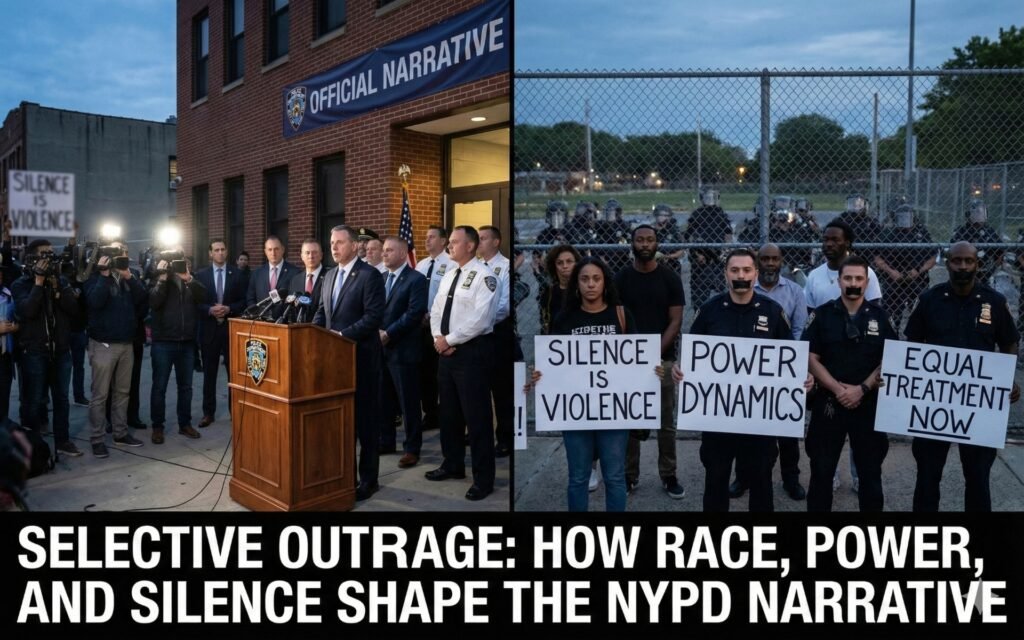
I. The Illusion of Reform
When the “Savior” Jessica S. Tisch was sworn in as New York City’s second female Police Commissioner—following Keechant L. Sewell—City Hall and its media partners rushed to frame the moment as proof of progress. A “modernizer” had arrived, they said. A tech-savvy reformer would bring order to a sprawling bureaucracy. For a city exhausted by scandal and distrust, the symbolism was irresistible: a woman at the helm, armed with data and decisive rhetoric, promising the future.
Yet symbolism is not structure. Beneath the celebratory headlines, the NYPD remains what it has long been: a hierarchy that rewards proximity to political power more than professional merit, and that calibrates scrutiny according to who holds authority—not what that authority does. Tisch’s ascension did not alter that basic reality. It repackaged it.
The contrast with her immediate predecessor, Edward A. Caban, is instructive. Caban led one of the most racially diverse executive teams in the department’s history. His command staff was stocked with career cops—Black and brown executives who had spent decades in patrol, in precinct houses, and in borough command. Whatever one thought of their decisions, their experience was not in doubt. They understood the job because they had lived it.
But during the Caban era, that very diversity became a target. Every action of his administration—budget calls, overtime practices, personnel moves—was challenged and caricatured through the familiar language of “DEI gone too far.” Insiders, commentators, and select media outlets treated the presence of Black and brown leadership as a variable to be managed, a risk factor to be controlled. Integrity rhetoric and diversity rhetoric fused into a single suspicion: that a more representative command structure was inherently less legitimate, less disciplined, less serious.
Tisch inherited this landscape and did something the public was never invited to name plainly: she reversed the optics while preserving the system. Her own résumé reflects no operational law-enforcement experience—no years riding in a radio car, no precinct command, no street-level crisis management. Around her, the Commissioner’s Office has been repopulated with political operatives, policy advisers, and legally trained insiders whose authority derives not from police work, but from their alignment with City Hall.
And yet, under Tisch, the standard of scrutiny has collapsed. Where Caban’s administration was dissected and second-guessed—often explicitly through the lens of race and “diversity”—Tisch’s has been insulated. Allegations that would have triggered sustained outrage under a majority-of-color command now struggle to break through the news cycle. The conduct is not materially different; the reaction is.
That is the core illusion of reform at One Police Plaza. The city did not move from dysfunction to accountability, or from politics to professionalism. It moved from diverse leadership under relentless suspicion to politically connected leadership under near-total protection. Race did not stop mattering; it became the silent organizing principle for who is presumed competent, who is presumed suspect, and who is left entirely out of the story.
This selective outrage is not new. As I have written before—from the Dutch rattle watch to slave patrols, from Tammany patronage to Broken Windows and stop-and-frisk—policing in New York has always been engineered to protect power first and explain that protection as “order,” “integrity,” or “reform.” The faces change, the slogans change, the press releases change; the underlying architecture of control does not. Tisch’s tenure is simply the latest iteration of an old design: upgrade the optics, preserve the hierarchy, and make sure the public conversation never touches the institution’s original purpose.
The choice to celebrate Tisch as a symbol of progress while erasing what was done to Caban’s administration is not accidental. It is how power preserves itself—by elevating representation when it is safely tethered to existing hierarchies and punishing it when it threatens to redistribute real authority.
The pages that follow examine that dynamic in detail: how the Caban administration was undermined through DEI tropes, how the Tisch administration has been shielded through political patronage and a conveyor belt of politically connected appointees, and how race, power, and silence now shape the NYPD narrative more than any written policy or public slogan.
What’s happening under Tisch is not novel—it’s historical repetition with a modern gloss. Every “new era” of NYPD leadership sells the same promise of modernization, accountability, or reform. Each time, the city mistakes cosmetic change for structural progress. And each time, the underlying power dynamics remain untouched.
This cycle has been running since the seventeenth century. As noted, New York’s first police force—the Dutch rattle watch—was not a civic experiment in safety; it was a corporate project in control. Born under the Dutch West India Company, the rattle watch patrolled not for justice but for commerce: guarding goods, enforcing curfews, and suppressing unrest that might threaten profits. That origin story matters, because it established the city’s enduring formula for policing: maintain order in service of power, not people.
From there, every reform has been a renovation of the same foundation. The slave patrols transformed racial subjugation into law enforcement. The Tammany machine turned police appointments into political currency. The twentieth century professionalized corruption under the banner of “integrity.” The twenty-first century has digitized it under “data-driven policing.”
The Tisch administration’s conveyor belt of political appointees is not a break from this lineage—it is its continuation. Just as the rattle watch answered to a trading company and Tammany’s captains answered to party bosses, today’s brass answers to City Hall’s political calculus. The illusion of reform is the NYPD’s oldest trick: rename the command, rebrand the leadership, rerun the same hierarchy.
Understanding this lineage is essential to understanding why selective outrage endures. When power changes hands but the structure doesn’t, scrutiny becomes a tool of convenience, not accountability. That’s why a majority-of-color command was labeled “DEI excess,” while a politically homogenous one is framed as “stability.” It’s why misconduct that once drew headlines now disappears into silence.
The next sections trace that lineage—how the architecture of control built by the Dutch rattle watch, reinforced by slave patrols, industrial strikebreakers, and the Tammany machine, still governs the department’s culture and its politics today.

II. DEI as Pretext — How the Caban Administration Was Racialized and Undermined
When Caban was elevated to Police Commissioner in 2023, City Hall called it historic: the first Latino Commissioner in the NYPD’s 178-year history. Headlines briefly celebrated the symbolism. Yet almost immediately, that symbolism was turned against him. The same commentators who had once demanded more “representation” began muttering about “identity hires,” “optics over merit,” and “too much DEI.” Inside One Police Plaza, the language was more coded but no less corrosive. Caban’s leadership team—men and women of color with decades of operational experience—was quietly framed as a risk factor, as though professionalism and representation were incompatible.
This is how racialized delegitimization operates in modern institutions. No one says “unqualified” outright; they say “political.” No one says “undeserving”; they say “diversity pick.” The critique masquerades as concern for standards while obscuring who set those standards and whom they have always excluded.
Caban inherited the same structural dysfunction every commissioner does: outdated technology, bureaucratic inertia, and political interference from City Hall. But unlike his predecessors, he faced an additional burden—the presumption that his command’s diversity was itself evidence of bias. Routine management decisions were parsed through a racial lens. When promotions favored officers of color, it was “identity politics.” When white executives advanced under Tisch, it became “merit.”
This pattern was not confined to gossip. It shaped press coverage and internal politics alike. Every operational dispute under Caban’s tenure—disciplinary reforms, budget negotiations, the handling of misconduct—was filtered through whispers about “DEI overreach.” The media narrative was primed to equate diversity with disorder, competence with whiteness, and accountability with instability.
That framing did real institutional damage. It undermined the credibility of seasoned commanders who had risen through the hardest assignments—Housing, Transit, Patrol Borough Bronx. It allowed entrenched factions within the department to resist Caban’s authority under the banner of “restoring professionalism.” And it set the stage for a smooth hand-off to Tisch, whose appointment was sold as a return to “discipline” and “stability”—a racialized inversion of the very terms used to disparage Caban.
The irony, of course, is that Caban’s team represented what reform was supposed to look like: leadership that actually reflected the city it served. Instead, the department and its media allies recast diversity as dysfunction. The message to future leaders of color was unmistakable: your presence will be tolerated only if it is symbolic, never structural.
The use of DEI rhetoric as a pretext for dismantling diverse leadership is not accidental—it is a form of institutional counter-insurgency. It preserves the racial and political status quo under the guise of protecting “standards.” And because the public conversation rarely examines who defines those standards, the inversion goes unchallenged.
This is not new. It is the same pattern that followed every attempt to broaden the department’s leadership ranks—from Benjamin Ward in the 1980s to Sewell four decades later. Each was praised as historic, undermined as political, and replaced by someone more palatable to the entrenched power structure.
Caban’s tenure, brief though it was, revealed how far the rhetoric of inclusion can be stretched to defend exclusion. It showed that in the NYPD, diversity is welcomed as decoration but punished as direction.
And when the inevitable backlash came—when Tisch’s appointment reversed years of progress and re-centered political patronage over operational experience—the silence of the press confirmed what the DEI backlash was always meant to achieve: a reset to the familiar order.
That order endures because it never admits what it fears most—competence combined with representation. The next section traces how that fear has shaped policing since its inception, from the Dutch rattle watch to modern command politics, revealing that what happened to Caban is not an anomaly but the latest echo of an institutional design nearly four centuries old.
III. Origins and Intent — Fitness as a Tool of Social Control
The myth that policing evolved to safeguard the public has always been useful—but false. From the first night watch in Dutch New Amsterdam to the modern NYPD, the function of policing has never been to protect the powerless. It has been to protect power from them. To understand how these reflexes persist, one must trace their origin—not in policy memos or reform reports, but in the colonial blueprint from which New York policing was born.
1. The Dutch Foundation
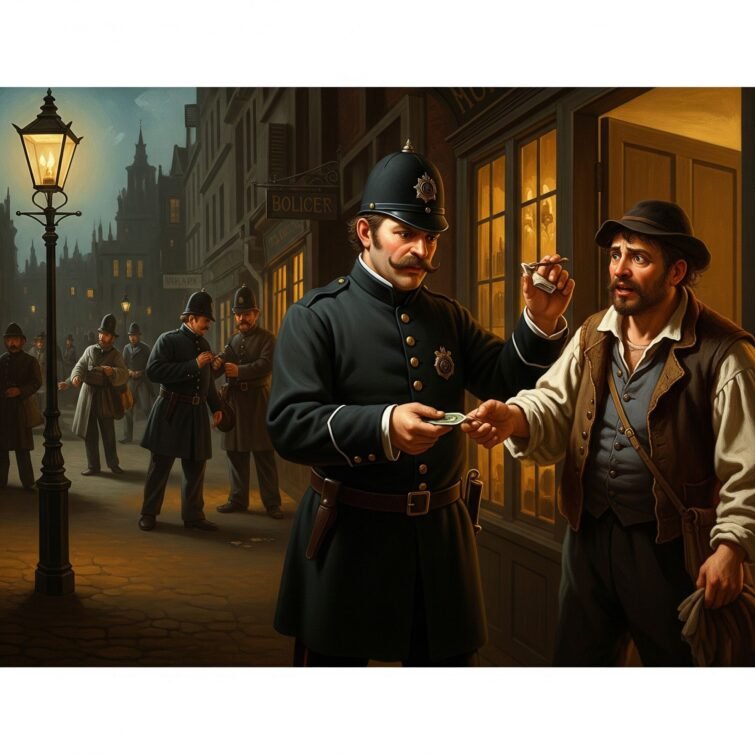
Seventeenth-century New Amsterdam was not a democratic experiment. It was a colonial outpost of the Dutch West India Company, a commercial venture obsessed with order, productivity, and profit. The city’s first formal patrol—the “rattle watch”—was created not to keep residents safe but to secure property, monitor laborers, and prevent unrest that might threaten trade.
These men were not neutral guardians. They were corporate agents enforcing curfews, tracking enslaved Africans, and policing the behavior of the poor and indentured. Their authority came from commerce, not consent. That is the seed from which the NYPD grew: policing as an instrument of economic regulation and social discipline, not civic protection.
2. The Continuity of Control
Each generation has simply updated that blueprint. After the Dutch came the British constables and colonial militias, who fused commercial order with imperial control. By the nineteenth century, political machines like Tammany Hall turned those same patrols into patronage networks—selling appointments, rewarding loyalty, and punishing dissent. Corruption wasn’t a deviation from the model; it was the model.
Even “reform” eras did not change the underlying purpose. The rhetoric shifted—from “public order” to “professionalism,” from “discipline” to “data”—but the hierarchy of control remained intact. Every iteration preserved three constants: protect property, contain dissent, and shield political power.
3. Fitness as a Modern Proxy
The language of fitness that dominates twenty-first-century policing—psychological testing, background screening, “command readiness”—is a sanitized descendant of that same colonial logic. What began as surveillance of physical bodies has become surveillance of minds. Under the pretext of ensuring integrity, institutions police conformity.
When the NYPD subjects recruits or executives to “psychological evaluation,” it is not merely testing competence. It is testing compliance—whether the candidate will conform to the institution’s unwritten rules of loyalty, silence, and hierarchy. Those deemed “unfit” often are not dangerous or unstable; they are inconvenient. The system defines normality as obedience.
Historically, such mechanisms have always emerged when the department feels threatened by inclusion. In the early twentieth century, “character investigations” were used to exclude Jewish, Irish, and Black applicants under the guise of moral fitness. In the twenty-first, similar rhetoric justifies sidelining whistleblowers or reformers. The vocabulary has changed; the gatekeeping function has not.
4. Race, Class, and the Manufacture of Legitimacy
By the time Caban ascended to Commissioner, this ideology was institutional muscle memory. Diversity could exist only so long as it did not challenge the inherited order. When it did, the same tools of control—integrity reviews, psychological holds, selective leaks—were deployed to restore equilibrium. Tisch’s administration, with its parade of politically anointed executives, did not invent the practice. It perfected it.
That is why scrutiny under Caban looked punitive while silence under Tisch looks “professional.” The system’s calibration of legitimacy still follows the colonial logic of worthiness: proximity to wealth, whiteness, and political patronage equals fitness. Distance from those centers equals suspicion.
5. The Historical Through-Line
The Dutch rattle watch enforced commercial obedience. The slave patrols enforced racial subjugation. Tammany’s police enforced political loyalty. Today’s NYPD enforces bureaucratic allegiance. The mission has evolved only in language, not intent.
To understand why reform keeps failing, one must understand that policing in New York has always been a method of governance, not a service. It was designed to secure hierarchy, not justice—to translate economic and political priorities into physical control. Every attempt at reform that leaves that purpose intact merely repaints the machinery.
The next section examines how this machinery was refined through political patronage and corruption—how Tammany Hall transformed policing into an enterprise of organized graft that still shapes the department’s internal economy and external loyalty.
IV. Political Patronage — How Corruption Became Culture at One Police Plaza
If the Dutch rattle watch created the structure and the slave patrols supplied the ideology, Tammany Hall provided the operating system. It converted policing into a marketplace of loyalty where every rank, post, and promotion had a price. The twentieth-century NYPD inherited not only Tammany’s corruption but its logic: power is currency, and currency is protection.
1. The Tammany Template
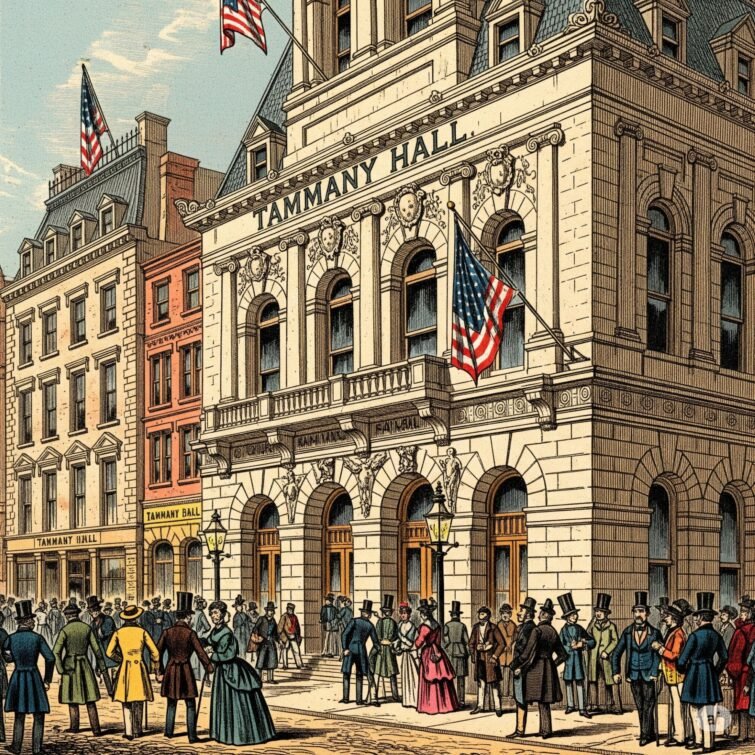
By the 1870s, the department had become a transactional bureaucracy. Patrolmen purchased assignments; precinct captains bought favor with ward leaders; commissioners traded promotions for political contributions. Reform commissions came and went, but none dismantled the patronage network because the network was not a side effect — it was the engine that kept city politics running.
The legacy endures. Every major internal scandal — from the Lexow hearings of 1894 to the Knapp Commission in 1972 to the Mollen Commission a century later — confirmed the same pattern: corruption adapts faster than reform. Once exposed, it mutates, hides in paperwork, or rebrands as “discretionary authority.”
2. The Modern Mutation
At One Police Plaza today, political patronage no longer wears the blunt face of cash envelopes. It operates through appointments, legal titles, and proximity to City Hall. The Tisch administration’s inner circle exemplifies this evolution: attorneys and aides with little operational experience occupying command roles once earned through decades in uniform. The badge has become a credential of affiliation, not achievement.
In earlier eras, the corrupt officer padded overtime sheets or collected bribes from saloon owners. The contemporary equivalent is the executive who secures a six-figure post for political loyalty, retroactively signs false time records, or shields allies from accountability. The exchange remains the same — protection for obedience — only the vocabulary has changed.
3. Cover-Ups as Governance
Under this model, the cover-up is not an accident of corruption; it is its method. Each falsified UF-28, each back-dated memo, each “lost” audit trail is both symptom and signal — proof that loyalty outranks legality. When Deputy Chief Richard S. Taylor can fabricate a year of time sheets with institutional blessing, that is not misconduct in isolation; it is policy by other means.
Political patronage thrives on two currencies: secrecy and selective enforcement. The same act that destroys a career at the precinct level becomes invisible when committed by an executive connected to the Commissioner’s Office. The hierarchy polices downward, never sideways or up.
4. The Media Compact
No patronage system survives without a public narrative to disguise it. Tammany Hall had its newspapers; the modern NYPD has its preferred outlets. The New York Post, long aligned with City Hall’s messaging, functions as the department’s narrative laundering machine. It sanctifies allies and vilifies dissenters, ensuring that corruption reads as “controversy” and reformers read as “disgruntled.”
This is how institutional misconduct becomes civic theater. When Tisch’s office leaks selective stories to rehabilitate insiders or to deflect scrutiny, the paper obliges — not as investigative journalism but as brand management. The alliance is symbiotic: the NYPD supplies access, and the press supplies amnesia.
5. From Patronage to Policy
Over time, what began as favor-trading hardened into administrative doctrine. Political loyalty now determines resource allocation, disciplinary leniency, and even reform priorities. The department’s command culture rewards those who defend the institution’s mythology and marginalizes those who expose its mechanics.
The result is a closed circuit of self-protection:
City Hall demands political obedience.
The Commissioner’s Office translates that obedience into promotions and immunity.
The media validates the façade of professionalism.
The public is told the system works.
It is the same Tammany triangle in twenty-first-century form.
6. The Cost of Continuity
The consequence of institutionalized patronage is not only corruption but decay. When advancement depends on connections rather than competence, operational integrity collapses. Investigations are shaped by politics; discipline is weaponized; leadership becomes performative. The department loses its professional core and retains only its bureaucratic shell — polished, insulated, and empty.
The Tisch administration’s appointments illustrate that transformation vividly. The conveyor belt that converts résumés and campaign loyalties into gold shields is not a metaphor; it is policy. It signals to the rank-and-file that allegiance outruns aptitude, that truth is negotiable, and that those who serve power are immune from consequence.
That is not reform. It is the perfection of corruption.
The next section traces how this culture of selective enforcement — sustained by media complicity and political insulation — metastasizes into official impunity, eroding public trust and ensuring that no amount of technology or rebranding can disguise the moral bankruptcy at the heart of the system.
V. The Outrage Gap — Who Gets Scrutinized and Why
Selective outrage is not random — it is the operating logic of institutional perception. It decides whose missteps are condemned as moral failure and whose are reframed as management style.
Under Caban, every administrative controversy became a morality play. Minor disputes over overtime, internal discipline, or scheduling were amplified into proof that diversity in command produced dysfunction. Anonymous “sources” supplied gossip; reporters supplied outrage. The subtext was unmistakable: competence, when embodied by officers of color, was conditional.
Under Tisch, the inverse applies. Allegations that would have dominated front pages — falsified time records, payroll fraud, unearned executive posts — barely register. Infractions that once invited demands for accountability now vanish beneath the language of “reorganization” and “strategic modernization.”
The difference is not performance. It is proximity. Power that looks familiar is presumed credible; power that looks different is presumed suspect. The NYPD’s internal and external audiences share that reflex. When leadership reflects whiteness, legacy, and political continuity, scrutiny is framed as disrespect. When leadership reflects diversity and independence, scrutiny is repackaged as responsibility.
This is the outrage gap: the moral asymmetry that turns similar conduct into opposite narratives depending on who holds the rank. It tells us who gets the benefit of the doubt and who gets the spectacle of doubt.
When power looks familiar, the press calls it reform.
When it looks diverse, it calls it disorder.
VI. The Caban Administration — Command by Experience
Caban’s administration was far from perfect, but it embodied what professional policing is supposed to mean: leadership forged in the field rather than in the press room. His executive team — many drawn from borough commands, Housing, Transit, and investigative divisions — represented decades of lived operational experience. They had stood post, supervised precincts, managed crises, and navigated the human realities of patrol.
Their credentials were practical, not performative. They knew the rhythms of a midnight tour, the bureaucracy of a command log, the split-second calculations of an arrest gone sideways. Their legitimacy came from labor, not lineage. Whatever their politics or policies, they had earned every bar and star through the slow accumulation of service.
And yet, despite being the most racially representative leadership corps in NYPD history, Caban’s command was subjected to scrutiny so exaggerated it bordered on caricature. The very diversity that should have been viewed as institutional maturity was recast as instability. Headlines focused on optics; insiders whispered about “too much DEI.” The narrative, repeated often enough, became self-validating: diverse leadership equals disarray.
This framing was not spontaneous. It was the culmination of decades of institutional reflex — a culture that treats representation as a threat to authority. In press coverage and political commentary alike, the measure of competence shifted from performance to appearance. When white or politically connected executives erred, they were “learning.” When Black or Latino executives made the same decisions, they were “unqualified.”
Caban’s tenure exposed that double standard in real time. The moment diversity acquired authority, the institution and its media allies began constructing the pretext to remove it. His administration became a controlled experiment in how far representation could rise before power demanded regression.
VII. The Tisch Administration — Command by Connection
Tisch did not inherit a blank slate; she inherited the same department, the same problems, and an internal architecture engineered over two decades by former Police Commissioners Raymond W. Kelly and William J. Bratton. Rather than disrupt that model, she has governed squarely within it. Where Caban’s leadership drew its legitimacy from field experience, Tisch’s draws from political affiliation and the endorsement of that Kelly–Bratton governance style—centralized control, managed messaging, and discretionary discipline. Her inner circle reads less like a command roster and more like a campaign résumé: consultants, attorneys, former mayoral aides, and loyalists whose authority rests not on operational law-enforcement experience, but on proximity to political power and to the policing philosophy Kelly and Bratton normalized.
The most telling transformation under Tisch is not structural but demographic. Where Caban’s cabinet reflected the city’s diversity—Latino, Black, and Asian executives who had risen through precincts and patrol—Tisch’s inner circle has reverted to a homogenous cohort of White male administrators, several of whom share overlapping social and professional networks rooted in elite law, consulting, and political circles. In prior administrations, such a composition would have been read as exclusionary; under Tisch, it is framed as competence. This reversal exposes how legitimacy in New York policing remains coded—when power looks familiar, it is presumed professional. When it looks diverse, it is presumed experimental.
That racial and cultural familiarity grants the Tisch administration immunity from the very skepticism that haunted Caban’s tenure. The media and political class no longer question experience, even where none exists. Figures with no patrol service, no investigative command, and no field accountability now occupy the top tier of One Police Plaza, their authority derived not from operational achievement but from their proximity to power and to one another. The result is an executive corps that is politically comfortable, racially uniform, and functionally untested—an inversion of reform that recasts exclusion as stability and diversity as disruption.
This inversion is visible in public records. LinkedIn profiles and post-50-a disclosures reveal a pattern of credentialism without command — degrees instead of tours, affiliations instead of arrests, policy briefs instead of precinct logs.
Leadership Profile of the Police Commissioner’s Office
[Compiled from publicly available records on 50-a.org and self-disclosed professional histories on LinkedIn]
Ryan Merola — Chief of Staff
Overview
Ryan Merola serves as Chief of Staff to the Police Commissioner, appointed in November 2024 after accompanying her through a decade of inter-agency transitions. His career is a textbook example of administrative succession within New York City’s political bureaucracy: beginning as an Urban Fellow, then rotating through the State Assembly, the NYPD’s civilian bureaus, the Department of Information Technology and Telecommunications (DoITT), and the Department of Sanitation (DSNY), before returning to One Police Plaza as Tisch’s senior aide.
Merola’s expertise lies in policy coordination, budget management, and inter-agency communications—skills valued by City Hall but far removed from patrol or investigative command. At every stage of his career, his advancement has mirrored Tisch’s own trajectory, suggesting a relationship defined by institutional trust and political alignment rather than technical or operational merit.
He holds a Juris Doctor from Brooklyn Law School but is not admitted to the New York State Bar and has no sworn law-enforcement or field-command experience.
Analytical Commentary
Merola embodies the Tisch administration’s governing philosophy: command by connection. His ascent to one of the NYPD’s highest administrative posts captures the department’s ongoing shift from professional policing to executive project management, where authority is no longer earned through operational command but through personal loyalty and political comfort. His presence underscores the Tisch model of leadership—rooted in reputational safety, bureaucratic control, and insulation from accountability.
Functionally, Merola serves not as a law-enforcement strategist but as Tisch’s political conduit, ensuring that her office remains aligned with City Hall’s tone, tastes, and optics. His career in sanitation logistics and information-technology governance exemplifies the NYPD’s transformation into a municipal holding company, a revolving circuit of managerial generalists whose chief function is to maintain the appearance of modernization while quietly centralizing power.
Merola’s rise also illustrates the de-professionalization and politicization of command under Tisch. Operationally seasoned deputies—leaders who earned their bars through years of crisis response, patrol command, and investigative experience—have been displaced by policy technocrats who specialize in risk avoidance and narrative management. The Commissioner’s Office now functions less as a command structure than as a bureau of political compliance, where decisions are filtered through considerations of loyalty, optics, and institutional preservation rather than public safety.
In that sense, Merola is not incidental—he is emblematic. His appointment represents the culmination of a long institutional evolution in which One Police Plaza has become an instrument of political comfort, nepotism, and cronyism, not public service. His trajectory confirms that under Tisch, the NYPD’s defining credential is no longer competence or courage—it is connection.
Inspector Joel T. Rosenthal – Deputy Chief of Staff
Overview
Inspector Joel T. Rosenthal represents the new archetype of NYPD executive ascension under the Tisch administration—career longevity without public accountability. Promoted to Inspector and designated as Deputy Chief of Staff to the Police Commissioner in November 2025, Rosenthal’s trajectory reveals an officer whose advancement aligns less with distinguished performance than with institutional protectionism and political compatibility.
His eighteen-year career spans multiple bureaus—Patrol Services, Detective Borough Bronx, Force Investigation Division, Deputy Commissioner of Public Information, and several precinct commands (1st, 73rd, 114th)—culminating in a top administrative role. Notably, his tenure includes documented misconduct, civil-rights settlements, and disciplinary findings that would have derailed lesser-connected officers.
Inspector Rosenthal has been named in eight lawsuits, resulting in $68,000 in total settlements. Among them, Lewis et al. v. City of New York (EDNY 2020) involved the false arrest of an entire family, including the pointing of a gun at a toddler; Love v. City of New York (EDNY 2014) described the violent and wrongful arrest of a motorist later released without charges. These cases reflect a pattern of constitutional violations consistent with unlawful detention, excessive force, and abuse of authority.
Additionally, CCRB records list six complaints with ten allegations, including a substantiated discourtesy charge and multiple abuse-of-authority findings. Most complaints involve Black and Hispanic male civilians, underscoring persistent racial disparities in enforcement conduct. Despite this documented history, Inspector Rosenthal faced minimal discipline—typically “instructions” or “command discipline”—and continued to rise through the ranks.
His educational résumé includes a Master of Public Safety from the University of Virginia (2023) and a Bachelor’s in Operations and Plant Management from the University of Delaware. Yet, his command performance is overshadowed by a career marked by litigation exposure, racialized complaints, and bureaucratic insulation.
Analytical Commentary
Inspector Rosenthal’s elevation to the Commissioner’s inner circle exemplifies the Tisch administration’s preference for loyalty over legitimacy. His profile blends bureaucratic familiarity with a record of misconduct—a combination that, in prior administrations, might have drawn disciplinary scrutiny but now signals internal trustworthiness.
Unlike politically detached reformers or field commanders with operational independence, Inspector Rosenthal functions as a protector of institutional continuity—a steady hand for a Commissioner who prizes compliance over candor. His portfolio, straddling communications, investigations, and patrol supervision, positions him as a gatekeeper between public narrative and internal accountability, precisely the interface where image management eclipses integrity.
That he was promoted despite multiple civil-rights settlements illustrates the department’s selective enforcement of discipline: the rank-and-file are punished for optics, while favored insiders are rewarded for loyalty. The Tisch administration’s willingness to elevate such figures sends a clear institutional message—proximity to the Commissioner absolves performance, ethics, and record.
Inspector Rosenthal’s presence near the apex of the NYPD hierarchy therefore is not incidental—it is ideological. He personifies the department’s structural inversion: misconduct without consequence, leadership without legitimacy, and reform without reformers. His rise affirms what has become the defining ethic of One Police Plaza under Tisch: an insulated command culture where political comfort, nepotism, and cronyism supersede competence and character.
Marc Heinrich – Deputy Chief of Staff and Senior Counsel
Overview
Marc Heinrich’s appointment as Deputy Chief of Staff and Senior Counsel to the Police Commissioner represents the consolidation of political privilege within the NYPD’s executive ranks. Heinrich is not a career law-enforcement officer; he is a political strategist groomed through elite academic institutions and campaign infrastructure. His résumé reflects a trajectory defined by proximity to power rather than service in any operational or public-safety capacity.
Before arriving at One Police Plaza, Heinrich served as Policy Director for the Office of the Mayor of New York City under Mayor Eric L. Adams—a role that positioned him squarely within City Hall’s political machinery. His earlier career includes tenure as a Senior Business Analyst at McKinsey & Company, Policy Director for Bullock for President, and Senior Policy Advisor for Bloomberg 2020. He also held brief stints at the U.S. Department of Justice (Tax Division) and the law firm Wachtell, Lipton, Rosen & Katz.
Despite this policy-heavy background, Heinrich has no sworn service, no field command experience, and no operational grounding in policing. Yet, within eight months of joining the department, he occupies one of its most powerful advisory positions, charged with shaping departmental governance, public messaging, and legal strategy—functions that directly influence discipline, accountability, and the NYPD’s public posture.
Analytical Commentary
Heinrich embodies the Tisch administration’s governing philosophy: command through credential, not competence. His appointment as Deputy Chief of Staff and Senior Counsel represents not a commitment to professional rigor but a calculated extension of Tisch’s managerial network—one in which political loyalty and policy fluency eclipse the traditional qualifications of law enforcement or legal practice.
Heinrich holds a Juris Doctor from Harvard Law School but is not admitted to the New York State Bar. Under New York Judiciary Law §§ 478 and 484, it is unlawful for any individual who is not duly admitted and registered as an attorney to practice law or hold themselves out as entitled to do so. The statutes explicitly prohibit the rendering of legal advice, preparation of legal instruments, or representation of any person or entity in a legal capacity by an unlicensed individual. Violation constitutes a misdemeanor under Judiciary Law § 485, carrying both criminal and professional consequences.
Overview
Deputy Commissioner Alex Crohn represents the most polished version of the Tisch-era technocrat—an attorney turned policy architect who bridges private-sector consulting, state bureaucracy, and internal NYPD operations. His career traces the through-line from elite legal training to political utility: from Davis Polk’s corporate practice to the Cuomo administration’s Executive Chamber, then into the de Blasio and Adams-era Mayor’s Office of Criminal Justice.
Crohn’s reentry into the NYPD under Tisch, after a two-year consulting interlude at Guidehouse, reveals the department’s evolving preference for policy professionals over command veterans. Though legally credentialed, his expertise lies not in policing or field command but in bureaucratic design—the management of reform as narrative, data, and metrics. His tenure at the Office of Research and Innovation, and now at Strategic Initiatives, positions him as the department’s internal futurist, responsible for advancing modernization rhetoric while maintaining structural continuity.
Analytical Commentary
Crohn’s rise within the Tisch administration illuminates the technocratic transformation of One Police Plaza. His role as Deputy Commissioner of Strategic Initiatives situates him at the intersection of policy branding and institutional preservation—tasked with translating City Hall’s political objectives into managerial form. He exemplifies the Tisch model of leadership: legally credentialed, administratively agile, and publicly marketable, yet structurally detached from the realities of police work.
Unlike predecessors who rose through investigative or command routes, Crohn’s professional authority derives from bureaucratic legitimacy rather than operational credibility. His return from the private consulting sector underscores the NYPD’s drift toward a revolving-door ecosystem, where civilian executives rotate between high-level city agencies, political offices, and firms that profit from the very systems they are later asked to “reform.”
In practice, Crohn functions as the institutional architect of the Tisch narrative—the face of modernization without structural reform. His portfolio focuses on performance metrics, digital systems, and public messaging that reinforce the image of efficiency, while substantive oversight, accountability, and ethical enforcement remain secondary. The language of “innovation” becomes a strategic shield, permitting continuity under the guise of progress.
Crohn’s career trajectory—from Davis Polk to City Hall to One Police Plaza—encapsulates the NYPD’s fusion of legal acumen with political obedience. He is the prototype of the department’s new leadership class: a lawyer-technocrat fluent in governance and optics, indispensable to the Commissioner’s inner circle not because of his command insight, but because of his capacity to translate political will into procedural legitimacy.
Ultimately, Crohn’s presence reflects a broader cultural inversion within the NYPD’s command structure. The modern department no longer views law as a restraint or accountability framework, but as an administrative instrument—one that can be leveraged to defend managerial choices, justify selective enforcement, and sanitize institutional narratives. In that environment, Crohn’s legal pedigree serves not as a safeguard of public integrity, but as a mechanism for bureaucratic self-preservation.
He stands, therefore, as the Tisch administration’s most sophisticated emissary of continuity: articulate, credentialed, and perfectly suited to manage the optics of reform while ensuring nothing fundamental changes beneath it.
Michael P. Baker – Assistant Chief, Commanding Officer
Overview
Assistant Chief Michael P. Baker serves as the Commanding Officer of the Police Commissioner’s Office, a role that positions him as the operational linchpin between the Commissioner’s executive staff and the Department’s bureaus. A 27-year veteran of the NYPD, Baker’s ascent follows a trajectory through administrative and analytical divisions rather than field or enforcement commands—specifically, the Office of Management Analysis and Planning (OMAP) and the Deputy Commissioner for Community Partnerships.
His career reflects the modern NYPD’s institutional preference for strategic managers over street commanders. Assistant Chief Baker’s expertise lies in internal systems design, statistical evaluation, and administrative oversight—skills that align with Tisch’s data-driven managerial ethos but diverge from the traditional command culture rooted in precinct, investigative, or field operations.
While Assistant Chief Baker’s tenure pre-dates Tisch, his consolidation of influence within the Commissioner’s Office coincides with her reorganization of executive functions. His placement as the Commissioner’s direct operational conduit signifies the administration’s shift from decentralized command accountability to tight executive centralization under a small cadre of politically trusted senior officers.
Analytical Commentary
Assistant Chief Baker personifies the institutional continuity that allows managerial regimes to persist despite leadership turnover. Unlike the politically imported technocrats surrounding Tisch, Baker represents the bureaucratic spine of the Department—an officer whose administrative longevity provides stability, but also reinforces the culture of internal loyalty over public transparency.
Assistant Chief Baker’s command of the Police Commissioner’s Office effectively makes him the custodian of executive operations—a role blending logistical control, information gatekeeping, and internal message discipline. His influence over scheduling, inter-bureau coordination, and document flow grants him quiet but formidable power within the NYPD hierarchy. Through this position, Baker functions less as a policy innovator and more as the Commissioner’s institutional shield—the gatekeeper who translates political directives into bureaucratic reality.
The significance of Assistant Chief Baker’s role lies not in controversy, but in what it reveals about the Tisch administration’s architecture of control. His career through OMAP and Community Partnerships demonstrates a commitment to administrative management rather than operational reform, aligning perfectly with Tisch’s governing model: a department run by analysts, lawyers, and project managers rather than field-tested law enforcement professionals.
Notably, Assistant Chief Baker’s involvement in the 2016 Giblin litigation—though minor in monetary terms—offers a glimpse into the recurrent managerial blind spots of NYPD’s upper echelons. The case, arising from a false Amber Alert and the mishandling of sensitive medical information, underscores the institutional risks of bureaucratic insularity: a system where decisions made without field perspective can produce real-world harm.
In the Tisch era, Assistant Chief Baker’s function has evolved from managerial oversight to institutional insulation. He ensures procedural continuity, filters internal dissent, and executes the Commissioner’s directives with the precision of a seasoned administrator. Yet his very presence at the helm of the Commissioner’s Office—unquestioned, unelected, and largely unexamined—illustrates the broader transformation of One Police Plaza into an instrument of political comfort and controlled narrative.
Baker’s legacy, therefore, is not scandal but structure. He is the connective tissue between past and present—a reminder that reform rhetoric often conceals the persistence of a system designed to manage appearances rather than transform accountability.
Craig M. Contrera – Executive Officer
VIII. Transparency as Propaganda: The Post-50-a Double Standard in Race and Power

The repeal of Civil Rights Law § 50-a was heralded as a breakthrough in police accountability—a symbolic dismantling of the secrecy that had long concealed misconduct and shielded power. Yet five years later, the promise of transparency has mutated into a system of selective exposure, where disclosure functions not as a tool of reform but as a weapon of political control. In the Tisch era, transparency has become propaganda—used to humiliate the disfavored, protect the loyal, and reinforce the hierarchies of race and rank that § 50-a once merely concealed.
Lisa White’s case exemplifies this inversion. As a civilian official, Deputy Commissioner for Employee Relations Lisa D. White was never covered by § 50-a at all, yet her internal communications and personnel history were selectively leaked and sensationalized across tabloid headlines. Her exposure was not compelled by law—it was engineered by choice. Through the NYPD’s internal press apparatus and its preferred megaphone, The New York Post, the image of a Black woman in authority was converted into a morality tale about “cronyism” and “favoritism,” timed to deflect attention from institutional misconduct elsewhere. The underlying message was racial and political: that Black loyalty is suspect, and Black advancement provisional.
By contrast, Deputy Chief Winston M. Faison, also Black but within the sworn hierarchy, has been subjected to a similar media pattern—rapid, exaggerated, and racialized amplification of internal disputes that would never reach print if the subject were white. The Post repeatedly framed his administrative disagreements as scandal and insubordination, echoing NYPD talking points nearly verbatim. His alleged “temper” became a headline; his decades of service, a footnote. The spectacle served a dual purpose: to feed the illusion of transparency while reaffirming the stereotype of volatility among officers of color.
Meanwhile, the Department’s white executives—Deputy Chief Taylor, for example—receive the opposite treatment. Despite credible allegations that Taylor failed for more than a year to file required UF-28 leave forms while collecting full pay, The Post and its NYPD sources remained silent. No exposé, no leak, no accountability. The same legal framework that legitimized White’s and Faison’s public humiliation became a shield for Taylor’s administrative impunity.
This asymmetry is not accidental. It is the logical evolution of post-50-a New York, where the discretion to disclose has replaced statutory prohibition as the instrument of control. The decision about whose records see daylight now rests entirely in the hands of those who manage the Department’s press pipeline. For Black and Latino officials, that pipeline functions as a public-relations guillotine; for white command-level loyalists, it is a vault. The result is a new caste system of exposure, in which law serves not as boundary but as alibi.
What § 50-a once achieved through secrecy, the Tisch administration now accomplishes through strategic illumination. The law no longer forbids transparency; it empowers its selective practice. The Post, operating as the NYPD’s external communications bureau, amplifies that selectivity into narrative truth. Its stories transform oversight into spectacle and racial disparity into click-through currency.
In this sense, post-50-a New York has not escaped its past—it has perfected it. Transparency, stripped of principle, has become the propaganda of accountability, where who gets exposed matters more than what is exposed. When the mechanisms of sunlight are commandeered by those in power, truth itself becomes a managed asset.
The paradox of post-50-a New York is that visibility has become another form of concealment. By deciding who deserves exposure and who deserves silence, One Police Plaza and The New York Post have converted transparency into theater—an instrument of racialized discipline masquerading as reform. What the law once prohibited through secrecy, the Department now controls through publication. The public sees the spectacle of accountability but not its orchestration; it hears the noise of scandal but never the sound of power itself.
That stagecraft leads directly to the next and more insidious layer of control: silence. If Section VIII revealed how transparency can be weaponized to destroy, Section IX exposes how silence is deployed to protect. Together, they form the twin pillars of the NYPD’s modern propaganda architecture—strategic exposure for the expendable, strategic omission for the powerful.
IX. The Media’s Complicity — The Post and the Politics of Silence
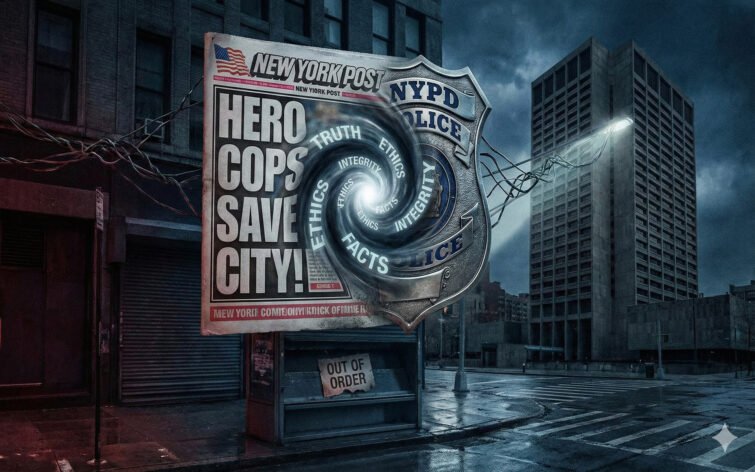
Every corrupt system requires an echo chamber, and in New York City that chamber is The New York Post. Once marketed as a populist tabloid, the paper now serves as the institutional proxy of One Police Plaza, laundering administrative failure into public reassurance. Under Tisch, this symbiosis has matured into something unprecedented: a permanent exchange of influence in which The Post supplies legitimacy and the NYPD supplies access. Together, they curate a public record that privileges loyalty over truth.
1. Silence as Editorial Policy
The Tisch administration’s communication strategy depends on selective muteness. When the misconduct of white executives surfaces—Deputy Chief Taylor’s unfiled UF-28 leave forms, for instance—no story runs, no follow-up follows, and no investigative column appears. Yet when the target is a Black or Latino official, the tabloid’s pages fill overnight with anonymous quotes, moral posturing, and photographic framing that implies guilt before any fact-finding occurs.
This pattern is not editorial accident; it is operational policy. Silence shields those who uphold the hierarchy, while exposure destroys those who threaten it. The paper’s restraint is purchased not with money but with proximity—the assurance that, so long as it protects the Commissioner’s narrative, it will remain the conduit of “exclusive” access.
2. The Economy of Access
In journalistic terms, The Post has converted its newsroom into a subsidiary of DCPI (the Deputy Commissioner for Public Information). The arrangement is simple: flattering coverage buys continued access to embargoed data, internal memos, and controlled leaks; adversarial inquiry guarantees exclusion from the information pipeline. Editors accept this trade because access yields headlines, and headlines sustain revenue. The consequence is structural—the public receives stories designed not to inform but to reinforce departmental legitimacy.
Inside the NYPD, this dynamic produces self-censorship. Public-information officers learn that uncomfortable facts are not to be shared with “unfriendly” outlets. Reporters learn that challenging official data costs them their beat. Over time, silence becomes not an omission but a credential—the proof of belonging to the club that speaks only when told.
3. The Politics of Narrative Sanitization
Under Tisch, The Post’s editorial voice has adopted the cadence of a press release. Crime statistics are accepted without scrutiny, disciplinary failures reframed as “policy disputes,” and leadership reshuffles presented as “strategic modernization.” The stories that never appear—sexual-harassment claims, misuse of psychological holds, retaliatory transfers—are more revealing than those that do. Each omission strengthens the illusion of competence.
The effect is cumulative: the paper functions as a moral filter, converting corruption into management, misconduct into modernization, and insubordination into reform. What results is not transparency but narrative sanitization, a deliberate reshaping of public perception that protects institutional continuity at the expense of truth.
4. Racialized Silence
Even silence has a color line. The Post’s editorial discretion reproduces the same racial hierarchy that governs the department it covers. Allegations against officers of color become moral parables; comparable allegations against white executives vanish. The absence of coverage about Taylor, Baker, or Contrera—each a white senior official tied directly to Tisch—contrasts sharply with the tabloid aggression directed at White and Faison. The difference lies not in fact but in framing: whiteness grants invisibility, Blackness demands exposure.
This selective quiet re-creates, in media form, the disciplinary asymmetry that defines the modern NYPD. It is not merely bias; it is enforcement by omission, a rhetorical continuation of the same inequities civil-rights law was written to abolish.
5. From Reporting to Reinforcement
The cumulative effect of this pattern is the de-professionalization of journalism. The Post no longer investigates the Department; it performs it. Its pages mirror press statements, its language mirrors internal memoranda, and its priorities mirror the Commissioner’s talking points. The watchdog has not been co-opted; it has been house-trained.
For the Adams–Tisch apparatus, this arrangement is ideal. By outsourcing narrative control to a private newspaper, the administration converts propaganda into protected speech. The result is a closed feedback loop in which the government supplies content, the paper supplies amplification, and the courts—bound by Sullivan—supply immunity.
6. The Consequences of Silence
When the press becomes a participant in state narrative, public oversight collapses. The public learns to measure truth by repetition, not by verification. Misconduct metastasizes beneath a canopy of positive headlines, and communities already alienated by selective policing see confirmation that accountability is conditional. Each unprinted story deepens the divide between perception and reality, governance and trust.
The cost is measurable in policy: oversight bodies defer to media consensus; legislators rely on curated data; and civil-rights violations multiply in the shadows of unchallenged success narratives. Silence, once merely unethical, becomes governance by omission.
7. Breaking the Cycle
Accountability will not emerge from the institutions that profit from its absence. The solution requires a structural re-alignment:
Independent Transparency Litigation: Major outlets must resume their historic role as plaintiffs, not partners, in FOIL and access-to-records actions.
Public Funding for Investigative Journalism: Establish city-chartered, independently governed investigative bureaus insulated from market and political pressure.
Disclosure Reciprocity: Require that any outlet receiving embargoed data from City Hall or the NYPD publish the full source documentation alongside its story.
Only by transforming access into obligation can journalism recover its civic purpose.
8. Silence as Consent
The Post’s collaboration with the Tisch administration represents not the corruption of one paper but the normalization of state-managed journalism in the nation’s largest city. Silence has become the new censorship, cloaked in the language of editorial independence. Until the press reclaims its adversarial duty, every headline that omits, every leak that flatters, and every statistic that comforts will stand as evidence of complicity.
When the story of this era is written honestly, it will record not that the NYPD deceived the press, but that the press deceived itself.
X. The Ethics of Outrage
Outrage, in a healthy democracy, is supposed to be a moral reflex — the public’s instinctive recoil against injustice. In New York, it has become a managed commodity, dispensed by those who control the narrative and withheld from those who challenge it. The Tisch administration has not eliminated scandal; it has engineered its distribution, deciding who may be condemned and who must be protected. In this new order, outrage no longer flows from conscience but from convenience.
1. Manufactured Morality
The spectacle of accountability that followed Caban’s brief tenure was not about reform; it was about removal. Caban, the son of the Bronx, embodied the kind of lived legitimacy the institution could not control. When the same structural rot persisted under Tisch — the same opaque promotions, the same data manipulation, the same indifference to statutory compliance — the outrage vanished. The message was unmistakable: ethics are optional when power is familiar.
This inversion reveals the ethical bankruptcy of the system itself. The public is invited to moralize about misconduct only when the target is expendable — a Black or Latino executive, a woman in mid-management, a dissenting psychologist, a probationary recruit. The outrage is choreographed, the silence deliberate. What passes for ethics is really editorial choreography: indignation outsourced to The Post and filtered through race, rank, and political allegiance.
2. Institutional Hypocrisy
The NYPD under Tisch has perfected the art of performative integrity. Press conferences speak of “accountability,” but internal discipline remains discretionary; data dashboards celebrate “modernization,” but the statutory violations remain untouched. The Commissioner’s office, now populated by lawyers without licenses and strategists without command experience, serves as the moral theater in which ethics are recited but never practiced.
This hypocrisy is not abstract. It corrodes public trust in the idea of lawful governance itself. Every unpunished violation of Education Law §§ 6512 and 6513, every misuse of psychological “holds,” every selective leak to a compliant press, signals that ethics are a privilege of proximity, not a duty of office.
3. The Collapse of Credibility
Legitimacy in public institutions depends on the perception of fairness. When citizens see that misconduct is punished by race and reported by rank, the moral compact collapses. The Tisch administration has traded that compact for control. Its version of “reform” is a set of optics — diversity in photographs, discipline in press releases, efficiency in dashboards — all designed to anesthetize inquiry.
The Post’s complicity converts that deception into common sense. Each unchallenged headline, each unprinted scandal, becomes a brick in the wall of manufactured credibility. Outrage becomes spectacle, not substance.
4. The Law Without Conscience
Law is supposed to anchor ethics. But in this regime, the law itself has become a performance — invoked to defend misconduct rather than to restrain it. The post-50-a transparency reforms, the Judiciary Law’s licensing provisions, and the constitutional protections of free speech have all been twisted into instruments of convenience. The Commissioner’s Office violates Education Law with impunity; the press hides behind Sullivan to justify distortion; the City invokes “ongoing investigation” to withhold records that should be public. Each actor operates within the letter of legality while betraying its spirit.
This is not governance; it is the simulation of legality. It replaces justice with process and ethics with procedure — a bureaucracy of compliance that ensures accountability never reaches the powerful.
5. The Moral Reckoning
The ethics of outrage demand consistency: if misconduct is intolerable under one administration, it must be intolerable under all. If transparency is law, it cannot depend on skin color or salary grade. And if the press claims independence, it must apply scrutiny evenly, not as a favor to friends. The current ecosystem fails every one of those tests.
The Tisch administration’s defenders will say she “professionalized” the Department. But professionalism without principle is bureaucracy with better lighting. The true measure of reform is not how well misconduct is hidden, but whether it is prevented. On that standard, the record speaks for itself.
6. Reclaiming Ethical Ground
New York does not need more ethics seminars or diversity slogans; it needs structural honesty. That means statutory enforcement without exception, disciplinary transparency without delay, and journalism that treats access as a duty, not a commodity. It means ending the culture of racialized outrage — where Black and Latino officers are punished in public while white executives are protected in silence.
Ethics are not performative; they are operational. They live in who gets promoted, who gets prosecuted, and who gets printed. Until that standard governs One Police Plaza and the newsroom alike, reform will remain rhetoric.
7. Final Indictment
The crisis at the NYPD is not about data or technology; it is about truth. The Commissioner’s office has become a sanctuary for the connected, and The New York Post its cathedral of absolution. Together they have transformed moral judgment into brand management.
New Yorkers deserve better — a city where truth is not traded for access, where outrage is earned by conduct, not assigned by color, and where leadership is measured by integrity, not proximity to power. Until that happens, the ethics of outrage will remain what they are now: the performance of accountability without its substance, the appearance of justice without its courage.
Until that day arrives, outrage will remain the city’s favorite substitute for truth—a moral performance staged for headlines, while the real work of reform is buried in footnotes and forgotten files.
But the record endures. And when appearances collapse, as they always do, the only structure left standing will be the one built on fact, not favor.
Epilogue — Truth as the Last Infrastructure
Every generation reaches a point when reform can no longer be outsourced to rhetoric. New York is there now. Its institutions still function, its headlines still print, its leadership still speaks the language of accountability—but the substance is gone. What remains is a city governed by appearance: transparency without access, reform without reckoning, journalism without inquiry.
Truth is the only infrastructure that can survive that decay. It is not a value to be admired; it is a system to be maintained. Like roads or bridges, it collapses when neglected—and when it collapses, every other civic structure falls with it.
The Tisch administration has mastered the art of management without honesty. One Police Plaza now operates as a climate-controlled ecosystem of control: insulated from criticism, protected by compliant media, and financed by public faith that it no longer deserves. The city’s great institutions—the press, the police, and the political class—have learned to coexist through a covenant of convenience. They have traded truth for access and monetized outrage to conceal the bureaucratic ritual of power.
To repair this, New York must treat truth as a public utility.
The law alone will not save us. Courts can compel disclosure but not honesty; statutes can mandate transparency but not integrity. The restoration of truth demands a moral awakening that treats honesty not as an aspiration but as an obligation. It requires enforcing the statutes already on the books—Education Law, Judiciary Law, and FOIL—with the same rigor applied to ordinary citizens. But it also requires that the work begin where the law ends: in the conscience of every person who refuses to repeat the lie, redact the record, or remain silent when silence serves power.
Journalism must rediscover its vocation. Its purpose was never entertainment or proximity to power; it was the defense of the public’s memory. When the newsroom becomes the echo chamber of the state, democracy itself becomes the casualty. The first duty of the free press is not to comfort the powerful but to remind them they are accountable.
The same duty belongs to citizens. Democracy is not a spectator sport. The right to know carries a corresponding burden to care—to read, to question, to demand, and to act. Every FOIL request, every whistleblower disclosure, every lawsuit for access to records is a small act of resistance against erasure. The republic of record survives only through such collective insistence.
The task is not to destroy the NYPD or the press but to return both to their constitutional purpose: one to enforce law, the other to expose it when law is ignored. When either fails, democracy becomes theater—performed with the precision of policy and the polish of public relations, but hollow at its core.
The rebirth of integrity in New York will not arrive with a new Commissioner or a new headline. It will begin when power once again fears exposure, when access no longer buys silence, and when outrage returns to its rightful owners—the people.
Until that day, every press release is a confession, every unasked question a collaboration, and every silence a monument to what this city once promised to be.