

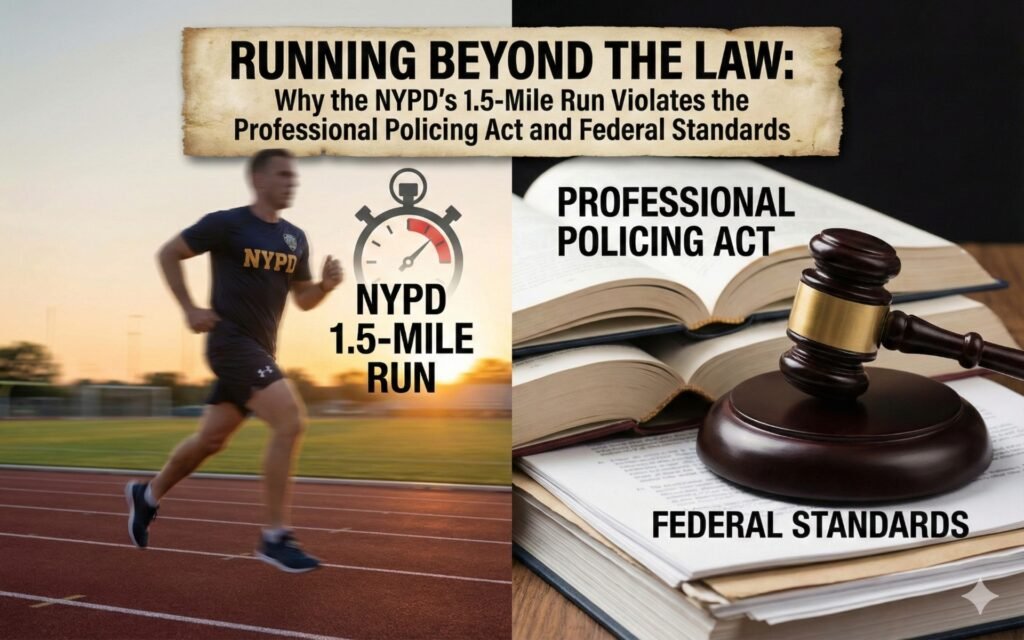
A Legal and Policy Analysis of the Professional Policing Act, Title VII, and New York’s Human Rights Framework
Dedication
This and all related thought-pieces examining the NYPD’s hiring and testing practices are dedicated to the thousands of applicants—past and present—whose legal rights to compete fairly for public employment have been denied or diminished by unlawful selection systems.
They include men and women who were excluded through unvalidated “character assessments,” disqualified by improper psychological screenings, rejected under scientifically unreliable Radioimmunoassay of Hair (RIAH) and Enzyme Immunoassay (EIA), or eliminated through physical standards—such as the 1.5-mile run—that neither state law nor federal regulation authorizes.
Their experiences reflect a systemic failure of governance and accountability that reaches beyond one department or one test. These essays are written in recognition of their perseverance, and in pursuit of the principle that every qualified applicant deserves a lawful, validated, and equitable opportunity to compete and serve.
PREFACE: A Personal Perspective on Real Policing By Eric Sanders, Esq.
For those arguing that the 1.5-mile run is “job-related” because police officers run, let me be very clear: Operationally, NYPD police officers do not run 1.5 miles chasing people. That is a very rare event.
In my entire career, I can recall running a long distance once—chasing a person who stole a vehicle through the Edgemere Houses in the Rockaways, from Beach 51st Street to Beach 59th Street, during a late tour. I caught and cuffed him alone.
On countless other occasions, I chased people much shorter distances, wrestled suspects, took guns out of their hands, and handled violent encounters that required strength, balance, control, and judgment—not distance running.
As a rookie assigned to the 101 Precinct, then-rookie Juanita Holmes (now Commissioner of Probation) and I once ran up 13 flights of stairs in the 41st Houses responding to a 10-13 (Officer Needs Assistance). The elevator was out. We did it. The job turned out to be unfounded—but that response is real policing. That is anaerobic power, not aerobic jogging.
And for the record: I passed the academy “qualification” run when I first entered the police academy—out of shape, in the winter—running along the FDR Drive from East 23rd Street to the Williamsburg Bridge and back in a little over 11 minutes. By the spring, shortly before graduation, I ran that same 1.5 miles in a little over 7 minutes.
None of that makes the 1.5-mile run job-related.
The legal argument has always been about objective standards, not individual ability. Courts have repeatedly ruled—going back to the 1970s—that the 1.5-mile run has no demonstrable relationship to the actual job of policing. The fact that I passed it, or that others passed it, does not change that reality.
Executive Summary
In theory, police fitness testing is designed to ensure readiness for duty. In practice, New York City’s continued use of the 1.5-mile run exposes a deeper problem: institutional defiance of the very statutes enacted to professionalize policing. What began as a measure of cardiovascular endurance has become a symbol of administrative overreach. In its current use by the NYPD, it has no lawful basis, no empirical validation, and no compliance with federal civil-rights standards.
Under the Professional Policing Act of 2021 (PPA), New York centralized the authority to establish and maintain uniform statewide standards for law-enforcement hiring, training, and certification within the Division of Criminal Justice Services (DCJS) and its Municipal Police Training Council (MPTC). Those authorities promulgated 9 N.Y.C.R.R. Part 6000, which establishes the statewide Medical and Physical Fitness Standards and Procedures for Police Officer Candidates. Section 6000.8 adopts the Cooper Institute physical-fitness battery — sit-ups, push-ups, and the 1.5-mile run — as the baseline screening standard for police agencies across the state.
But the same regulation includes an escape hatch: § 6000.8(a)(3) authorizes an agency to substitute an element of the test battery, provided that the substitute is validated to measure “the candidate’s physiological capacity to learn and perform essential job functions.” The NYPD lawfully exercised that option by developing and validating the Job Standard Test (JST) — an obstacle-based assessment simulating actual patrol and pursuit tasks. Once DCJS approved the JST as the NYPD’s screening model, any additional physical test functioning as a pass/fail gate became a separate selection procedure subject to independent statutory and UGESP validation requirements.
That approval cut both ways. The City may use the JST instead of, not in addition to, the Cooper battery as a pass/fail condition of entry or retention. Any continued or parallel use of the 1.5-mile run within NYPD screening — whether as a formal requirement, an informal qualifier, or a back-channel “fitness check” — falls outside the authority granted by Part 6000 and the PPA. It is, by definition, unlawful.
The problem extends beyond Albany’s jurisdictional lines. Under the Uniform Guidelines on Employee Selection Procedures (UGESP), 29 C.F.R. Part 1607, every employment test must be both job-related and validated for business necessity. There is no publicly available, professionally accepted study demonstrating that completion time on a 1.5-mile endurance run predicts an officer’s field performance, defensive tactics proficiency, or public-safety effectiveness. The Cooper metrics measure aerobic conditioning in the abstract, not the essential functions of modern policing. Their continued use therefore violates Title VII of the Civil Rights Act of 1964 by imposing a non-validated selection device with foreseeable disparate-impact consequences.
The result is a regulatory paradox: the NYPD, the nation’s largest police department, operates outside the framework designed to standardize law-enforcement professionalism statewide. The PPA was enacted to eliminate arbitrary and exclusionary practices — to ensure that every test of fitness or character rests on law, science, and fairness. The City’s persistence in administering an unapproved 1.5-mile run resurrects precisely the inequities the statute was meant to abolish.
This essay dissects that failure. It traces the legislative intent of the PPA, the regulatory authority of Part 6000, and the validation principles embedded in the UGESP. It argues that New York cannot modernize policing while tolerating relics of non-compliance — and that lawful reform begins with fidelity to the very standards already on the books.
Because professional policing does not mean running faster; it means running within the law.
I. The Statutory Framework — Part 6000, the Professional Policing Act, and the Limits of Administrative Authority
The Professional Policing Act of 2021 (PPA) was enacted to end the era of fragmented, arbitrary police hiring practices in New York. For decades, more than 500 municipal agencies operated under inconsistent physical, psychological, and medical standards, resulting in wide disparities in access, diversity, and due process. The Legislature responded by amending Executive Law §§ 839 and 840 to vest exclusive authority in the Division of Criminal Justice Services (DCJS) and its Municipal Police Training Council (MPTC) to set statewide hiring, training, and certification requirements for all police agencies. The purpose was unambiguous: to “standardize professional qualifications” and ensure that police employment decisions were grounded in science, not subjectivity.
This reorganization was not symbolic—it was structural. By centralizing rulemaking under DCJS and the MPTC, the Legislature stripped individual police departments of unilateral authority to create or modify physical standards. The PPA thereby codified a constitutional principle that had long been aspirational: equal access to public service through uniform, validated criteria. Any agency-imposed deviation from those standards undermines not merely administrative consistency, but legislative command.
A. The Statewide Standard — The Cooper Battery
The operational embodiment of that legislative intent is 9 N.Y.C.R.R. Part 6000, titled Medical and Physical Fitness Standards and Procedures for Police Officer Candidates. Section 6000.8 adopts a baseline physical fitness test developed by the Cooper Institute for Aerobics Research, requiring performance at the 40th percentile on three measures:
Sit-ups – assessing core muscular endurance;
Push-ups – testing upper-body strength;
1.5-mile run – measuring aerobic capacity.
These three components constitute the default statewide standard for all police officer candidates. They are not mere administrative preferences but regulatory mandates adopted through formal rulemaking under the State Administrative Procedure Act (SAPA).
B. The Substitution Clause — § 6000.8(a)(3)
Section 6000.8 of Title 9 of the New York Codes, Rules and Regulations prescribes how municipal civil service commissions must administer physical-fitness screening tests for police-officer candidates. It establishes a procedural framework that prioritizes objectivity, safety, and pre-offer neutrality in hiring.
Under § 6000.8(a)(1), a commission must designate a qualified trainer to conduct the physical-fitness test before any conditional offer of employment. The purpose is to measure “the underlying physiological capacity of a candidate to learn and perform the essential job functions” of an entry-level police officer. The test must precede the post-offer medical examination to ensure that no medical disqualification is influenced by performance results.
Before the test is administered, § 6000.8(a)(2) authorizes the commission to require a physician’s certification confirming the candidate’s ability to participate safely, provided that such certification is required uniformly for all applicants. This uniform-application clause reinforces the PPA’s central principle: no discretionary barriers, no unequal screening.
The key language appears in § 6000.8(a)(3):
“If a candidate is unable to perform an element of the test, the municipal civil service commission may provide for an alternative element to be substituted, which, in the judgment of such commission, will render a demonstrably valid assessment of the individual’s physiological capacity for the particular factor to be measured.”
This provision is not a blank check to impose additional pass/fail gates; it requires that any alternative element be demonstrably valid for the physiological factor being measured. Substitution is permitted only when a candidate cannot perform a specific element and only where the commission determines that the alternative yields a demonstrably valid assessment of the same physiological factor. The substitution must therefore be:
Individualized — applied to a candidate who cannot perform a specific element, not as a wholesale departmental replacement;
Demonstrably Valid — producing equivalent measurement of the physiological attribute originally intended (e.g., endurance, strength, agility); and
Within Civil-Service Oversight — decided by the municipal civil service commission, which acts as the appointing authority for competitive examinations.
Thus, § 6000.8(a)(3) was never designed to authorize an agency such as the NYPD to invent a parallel test regimen or reintroduce obsolete standards. Its narrow function is remedial—to accommodate candidates where an element poses a barrier unrelated to job performance—while preserving the integrity of the statewide testing protocol.
Any broader reinterpretation of this clause, such as using it to justify re-adopting the 1.5-mile run as an independent qualification metric, exceeds the commission’s delegated authority and conflicts with both the text and intent of Part 6000. The rule provides for individual substitution, not institutional reinvention.
C. The NYPD’s Election — The Job Standard Test (JST)
Pursuant to § 6000.8(a)(3), the New York City Police Department developed the Job Standard Test (JST)—a timed obstacle course simulating real-world policing tasks. Candidates climb stairs, vault barriers, drag a body-weight dummy, and engage in controlled physical contact designed to approximate suspect restraint. The JST was subjected to empirical validation demonstrating its predictive relationship to on-duty performance outcomes such as pursuit, apprehension, and endurance under load-bearing stress. Upon completion of this validation, DCJS approved the JST as the Department’s formal substitute for the Cooper battery.
Once NYPD adopted an obstacle-based screening model (the JST), any separate 1.5-mile run requirement becomes its own selection procedure. If it causes disqualifications or forced resignations, it must independently satisfy Part 6000 and UGESP validation standards. The Department cannot administer both tests simultaneously or resurrect an unvalidated measure outside its validated framework. Any such practice—whether labeled “pre-screening,” “conditioning,” or “fitness maintenance”—falls outside DCJS authority and thus violates the Professional Policing Act and Part 6000.
The problem is not that endurance can never be measured. The problem is that the NYPD is using the 1.5-mile run as an additional, coercive pass/fail gate—without showing, through UGESP-grade validation, that it measures the minimum capacity required to perform the job and without fitting within the state’s standardized Part 6000 framework. That is why it is unlawful.
D. What “Validation” Actually Requires
Under both DCJS regulations and federal law, “validation” is not rhetorical—it is empirical. A test is valid only if there is documented, statistical correlation between performance on that test and the ability to perform essential job functions. Validation requires:
Job Analysis – identification of core physical demands through systematic observation;
Criterion-Related Evidence – data linking test scores to job performance metrics; and
Professional Review – certification that the test measures job necessity, not arbitrary fitness.
This process ensures that physical standards reflect operational competence rather than tradition or preference. A 1.5-mile run—derived from military endurance assessments—measures aerobic fitness, not functional policing ability. It lacks empirical linkage to essential job performance and therefore cannot satisfy validation requirements under either DCJS or federal law.
E. The Federal Overlay — UGESP and Title VII
The Uniform Guidelines on Employee Selection Procedures (UGESP), 29 C.F.R. Part 1607, codify the federal requirement that all employment selection procedures be job-related and consistent with business necessity. Under Title VII of the Civil Rights Act of 1964, any test that has a disparate impact on protected groups must be validated in accordance with the UGESP. Failure to meet those standards exposes the employer to liability, even absent discriminatory intent.
Federal courts have consistently invalidated endurance and agility tests that lack empirical validation or demonstrable linkage to essential job duties. In United States v. City of Erie, 411 F. Supp. 2d 524 (W.D. Pa. 2005), the court enjoined the Erie Police Department’s use of a physical-agility test containing a 1.5-mile run after finding a severe disparate impact on female candidates and no credible validation demonstrating that aerobic endurance at that level was a necessary qualification for police service. Applying the Griggs and Lanning standards, the court concluded the City was unlikely to prove business necessity and ordered the development of a scientifically validated alternative.
Likewise, in Pietras v. Board of Fire Commissioners of the Farmingville Fire District, 180 F.3d 468 (2d Cir. 1999), the Second Circuit—binding authority in New York—held that a physical-agility test, which included a timed endurance run and eliminated the female plaintiff, violated Title VII because the fire district failed to produce any acceptable validation study connecting the test to actual firefighting duties. The court emphasized that “generalized assumptions about strength or stamina” are insufficient under Title VII and the Uniform Guidelines on Employee Selection Procedures (UGESP), 29 C.F.R. Part 1607.
This reasoning echoes the seminal United States v. City of Chicago, 549 F.2d 415 (7th Cir. 1977), where the court struck down the Chicago Police Department’s use of non-validated written and physical examinations that disproportionately excluded minority and female applicants. The Seventh Circuit affirmed broad injunctive relief, holding that selection devices lacking professionally acceptable validation constitute unlawful exclusion under Title VII and the Equal Protection Clause.
Together, these cases articulate a uniform national doctrine: employment selection procedures—including endurance or agility tests—that impose disparate impact without scientifically validated proof of job-relatedness are per se discriminatory. This rule applies with full force in New York, where both the Professional Policing Act of 2021 and 9 N.Y.C.R.R. Part 6000 require that all fitness standards be validated, evidence-based, and consistent with lawful selection procedures. The continued use of the 1.5-mile run, unsupported by validation or state authorization, thus stands in direct conflict with both federal and state law.
F. The Legal Consequence
The combined effect of these authorities is unmistakable. The continued use of the 1.5-mile run:
Violates State Law — exceeding the statutory limits imposed by 9 N.Y.C.R.R. Part 6000 and contravening the legislative intent of the Professional Policing Act of 2021;
Contravenes Federal Law — failing the Uniform Guidelines on Employee Selection Procedures (UGESP) validation requirements and exposing the City to Title VII disparate-impact liability under the standards articulated in United States v. City of Erie, Pietras v. Board of Fire Commissioners, and United States v. City of Chicago; and
Compromises Equal Access — reinstating unvalidated endurance barriers the Professional Policing Act was enacted to abolish.
Lawful policing begins with lawful selection. The 1.5-mile run—unsupported by scientific validation, unauthorized by the Division of Criminal Justice Services, and inconsistent with both state and federal law—represents not merely administrative error but a systemic failure of compliance. The Professional Policing Act does not sanction endurance contests masquerading as qualification tests. It demands empirical validation, statewide uniformity, and fidelity to the rule of law.
II. Institutional Evasion: How the NYPD Circumvents Statutory and Regulatory Oversight
The New York City Police Department’s continued reliance on unvalidated endurance standards, including the 1.5-mile run, is not an administrative misunderstanding—it is a deliberate circumvention of statutory and regulatory authority. Behind every unlawful testing practice lies an institutional calculus: it is easier to ignore the law than to comply with it. The Department’s actions reveal a consistent pattern of regulatory evasion that violates both the letter and spirit of New York’s Professional Policing Act of 2021 and 9 N.Y.C.R.R. Part 6000.
A. Circumvention by Redefinition
Rather than formally seeking DCJS authorization for a new validated testing standard, the NYPD has historically attempted to reclassify endurance assessments as internal “pre-employment fitness indicators” or “supplemental readiness measures.” This semantic sleight of hand serves one purpose: to detach the test from the statutory framework that governs all police-officer candidate evaluations. Under Part 6000, no such distinction exists. Every physical-fitness test administered by a police department must conform to the validated test battery approved by DCJS or a duly authorized substitute. By redefining the 1.5-mile run as an informal screening tool, the Department sidesteps oversight while maintaining a gatekeeping mechanism unsupported by evidence or law.
B. Circumvention by Delegation
The Department also exploits its relationship with the DCJS to diffuse responsibility. In practice, the NYPD’s Candidate Assessment Division often directs testing contractors or department examiners to administer components that exceed or modify state-approved standards, then characterizes the deviation as a “local requirement.” This bureaucratic layering insulates the Department from direct accountability while ensuring that no single office bears formal responsibility for compliance. The result is a shadow system of testing—externally administered, internally orchestrated, and legally indefensible.
C. Circumvention by Validation Substitution
Section 6000.8(a)(3) permits limited substitution of test elements only when a municipal civil-service commission determines that an alternative element “renders a demonstrably valid assessment” of a candidate’s physiological capacity to perform essential job functions. The operative phrase is demonstrably valid. The NYPD’s endurance assessments have never undergone a DCJS-approved validation study, nor have they been reviewed by any independent psychometric authority. There is no publicly available, professionally accepted study demonstrating that the NYPD established that “field performance indicators” or “academy attrition rates” satisfy the professional validation criteria required under the Uniform Guidelines on Employee Selection Procedures. Substitution without validation transforms administrative discretion into unlawful improvisation.
D. Circumvention by Oversight Fatigue
The most insidious form of evasion is bureaucratic exhaustion. DCJS—constrained by chronic audit understaffing and the political friction inherent in regulating powerful local entities—has neither the resources nor the mandate to effectively monitor every municipal agency’s compliance with Part 6000. The NYPD exploits this gap. By presenting deviations as longstanding practice, it cultivates institutional inertia—what begins as a pilot becomes custom, and what becomes custom hardens into policy. The Professional Policing Act’s oversight mechanisms, conceived as dynamic instruments of reform, are thus rendered inert through sheer administrative endurance.
E. The Consequence of Institutional Defiance
The cumulative effect of these evasions is a parallel system of law. The NYPD administers physical standards that have no statutory basis, enforces them as conditions of employment, and defends them through bureaucratic opacity. Each unlawful test disqualifies candidates who might otherwise meet every legitimate standard of police service. Each act of defiance corrodes public trust in the fairness and transparency of the hiring process. The Department cannot claim to uphold law while operating outside it.
The Professional Policing Act of 2021 was enacted to end precisely this type of institutional exceptionalism. Its mandate is unambiguous: statewide uniformity, scientific validation, and transparent accountability. The NYPD’s continued reliance on unapproved endurance testing—without DCJS validation, without statutory authority, and without empirical justification—constitutes a direct violation of state law and a profound breach of public trust.
III. The Federal Overlay — UGESP, Title VII, and the Unlawfulness of the 1.5-Mile Run
The State of New York’s statutory scheme does not exist in isolation. Every employment-testing regime administered by a private or public employer operates within the broader federal framework of Title VII of the Civil Rights Act of 1964 and its interpretive regulations, the Uniform Guidelines on Employee Selection Procedures (“UGESP”), 29 C.F.R. Part 1607. Together, these authorities form the national standard for determining whether a selection procedure is lawful, fair, and empirically justified.
A. The UGESP Mandate
The UGESP requires that any selection procedure producing an adverse impact on a protected group must be demonstrably job-related and consistent with business necessity. Validation is not a matter of administrative discretion; it is a legal prerequisite. Under § 1607.5, an employer must establish through professionally acceptable methods—typically criterion-related or content validation—that a test accurately measures the skills and abilities essential to the job. A test that merely measures general physical fitness or endurance fails this standard if those qualities are not shown to be indispensable to job performance.
In practice, the NYPD’s 1.5-mile run requirement cannot survive this scrutiny. There is no publicly available, professionally accepted study demonstrating the ability to run that distance within a specified time to the actual operational duties of an NYPD police officer. The Department has not produced, nor has DCJS approved, any data showing that cardiovascular endurance at that threshold predicts academy success or field performance. The absence of such proof places the NYPD squarely outside the UGESP’s compliance framework.
B. Federal Precedent: How Courts Treat Unvalidated Endurance Gates
Federal courts do not treat physical-fitness tests as exempt from Title VII. When an endurance or agility requirement disproportionately screens out protected groups, the employer must prove—through professionally acceptable validation—that the test measures the minimum capacity needed to perform essential duties. Griggs v. Duke Power Co., 401 U.S. 424 (1971).
That principle is concrete in the public-safety context. In Pietras v. Board of Fire Commissioners, 180 F.3d 468 (2d Cir. 1999), the Second Circuit rejected a timed physical test where the employer could not connect the endurance component to actual job requirements through acceptable validation. In United States v. City of Chicago, 549 F.2d 415 (7th Cir. 1977), the court invalidated police selection devices that produced adverse impact without professionally acceptable proof of job-relatedness.
And in United States v. City of Erie, 411 F. Supp. 2d 524 (W.D. Pa. 2005), the court enjoined a physical-agility test that included a 1.5-mile run where the employer lacked a credible, current job-task analysis and validation showing that long-distance endurance at that level was necessary for police work.
These cases reflect a consistent rule: a public-safety label does not substitute for empirical proof. Where an endurance run operates as a pass/fail gate and the employer cannot validate it as measuring the minimum job-related capacity, its continued use is unlawful under Title VII.
C. The Griggs Standard and Its Progeny
Griggs established that employment practices “fair in form but discriminatory in operation” are prohibited unless justified by business necessity. Later decisions refined that rule: Albemarle Paper Co. v. Moody, 422 U.S. 405 (1975), required employers to demonstrate that a test’s predictive validity was established by professionally acceptable methods; Dothard v. Rawlinson, 433 U.S. 321 (1977), struck down Alabama’s height-and-weight requirements for correctional officers as lacking any proven link to job performance. Together, these cases define the threshold that the NYPD’s endurance testing must meet—and has not.
D. The Legal Consequence
The combined weight of federal authority leaves no ambiguity:
Violation of State Law: The 1.5-mile run exceeds the authority granted under Part 6000 and contravenes the Professional Policing Act’s requirement of statewide uniformity and validation.
Contravention of Federal Law: The test fails UGESP validation requirements, invites disparate-impact liability under Title VII, and conflicts with the evidentiary standards articulated in Griggs, Pietras, and City of Chicago.
Erosion of Equal Access: It re-introduces barriers that the Professional Policing Act was enacted to eliminate, disproportionately excluding otherwise qualified candidates—particularly women—without any demonstrable connection to job performance.
Lawful policing begins with lawful selection. The 1.5-mile run—unsupported by validation, unauthorized by DCJS, and inconsistent with both state and federal law—reflects a systemic failure of compliance. The Professional Policing Act does not permit endurance contests disguised as qualifications; it demands empirical evidence, uniformity, and fidelity to the rule of law.
IV. Civil-Rights Implications and the Broader Policy Failure
The misuse of physical-fitness standards such as the 1.5-mile run is not merely a technical or administrative breach; it constitutes a civil-rights violation with constitutional and statutory dimensions. When public employers adopt or maintain selection procedures that are facially neutral but functionally exclusionary, they cross the threshold from bureaucratic negligence into systemic discrimination. Across federal, state, and local law, compliance is non-delegable — government cannot trade statutory duty for convenience or disguise evasion as discretion.
A. Title VII and the Doctrine of Disparate Impact
Title VII of the Civil Rights Act of 1964 prohibits employment practices that, while facially neutral, disproportionately exclude protected groups unless the employer can demonstrate that the practice is job-related and consistent with business necessity. The Griggs framework remains the controlling analytic model: once a plaintiff establishes adverse impact, the burden shifts to the employer to prove empirical job-relatedness. If the employer fails, the practice is unlawful—intent is immaterial.
Applied here, the NYPD’s 1.5-mile run fails at the first step and collapses at the second. Data from comparable agencies demonstrate that long-distance endurance tests exclude women and older applicants at rates exceeding 80 percent. No validation study, DCJS certification, or independent expert analysis has been produced to establish predictive value. The absence of proof converts the test into an arbitrary screen, presumptively unlawful under Griggs, Albemarle Paper Co. v. Moody, 422 U.S. 405 (1975), and Dothard v. Rawlinson, 433 U.S. 321 (1977).
B. Section 1983 and Institutional Liability
Because the NYPD operates as an arm of the City of New York, the continued enforcement of an unvalidated physical standard implicates municipal liability under 42 U.S.C. § 1983. Under Monell v. Department of Social Services, 436 U.S. 658 (1978), a municipality is liable when an official policy, practice, or custom causes the deprivation of federal rights. That doctrine extends beyond formally enacted rules to include patterns of unconstitutional conduct that are known to, and tolerated by, policymakers.
The Second Circuit’s recent decision in Chislett v. New York City Department of Education, 157 F.4th 172 (2d Cir. 2025), reaffirmed that Monell liability attaches not only to explicit municipal policies but also to “persistent and widespread practices” that continue through the “constructive acquiescence of senior policymakers.” Chislett emphasized that municipal inaction in the face of known illegality can constitute a de facto policy of deliberate indifference. This principle aligns with earlier holdings in Lucente v. County of Suffolk, 980 F.3d 284 (2d Cir. 2020), and Cash v. County of Erie, 654 F.3d 324 (2d Cir. 2011), both of which recognized that a municipality’s failure to supervise, train, or intervene—despite clear notice of unconstitutional practices—creates actionable liability under § 1983.
Here, the NYPD’s persistence in enforcing an unvalidated physical standard—despite repeated statutory mandates, public comment, and the availability of validated alternatives—constitutes precisely the sort of deliberate indifference described in Chislett, Lucente, and Cash. The Department cannot shield itself behind subordinate administrators when its leadership ratified the practice, publicized the standard, and used it to disqualify candidates. Each of those acts reflects a conscious municipal choice, satisfying Monell’s requirement of policy attribution. Under this precedent, the City’s liability is not derivative or accidental—it is institutional, deliberate, and direct.
C. Equal-Protection Dimensions
While disparate-impact theory suffices under Title VII, the Equal Protection Clause of the Fourteenth Amendment adds a constitutional overlay. When a government employer applies criteria that predictably and unnecessarily exclude specific groups without rational connection to legitimate objectives, it violates the equal-protection guarantee of fair and equal access to public employment. Courts have consistently held that arbitrary physical standards—especially those unsupported by validation—fail even rational-basis scrutiny. The endurance component of the NYPD’s 1.5-mile run, untethered to actual policing functions, cannot survive constitutional review.
D. The Professional Policing Act and the Promise of Equity
The Professional Policing Act of 2021 was enacted to modernize police standards through transparency, evidence, and accountability. By reverting to unvalidated endurance testing, the NYPD has undermined the very statutory reform designed to promote professionalization and equity. The Act’s legislative history reflects an explicit intent to align New York’s hiring practices with national civil-rights norms and the UGESP validation framework. Each unauthorized deviation from Part 6000 re-creates the discriminatory barriers the PPA sought to eliminate.
The irony is structural: a statute conceived to professionalize law enforcement is being subverted by the same institutional culture that equates exclusion with excellence. This inversion not only erodes compliance but perpetuates the racial, gender, and socioeconomic disparities that the PPA was meant to correct.
E. The Broader Policy Failure
At its core, the 1.5-mile run controversy exemplifies how bureaucratic inertia can reproduce inequality under the guise of “fitness” or “tradition.” When agencies ignore empirical validation and instead rely on anecdotal rationalizations or inherited practices, they re-create the very biases civil-rights law was enacted to dismantle. The harm extends beyond individual applicants: it damages public trust, invites costly litigation, and distorts the composition of police forces across the state.
The pattern mirrors what federal courts have condemned for nearly five decades: employment standards rooted in mythology rather than measurement. Each unvalidated endurance test is not just a legal defect; it is a policy choice that communicates who belongs in uniform and who does not. Until that choice is corrected through transparent validation, oversight, and enforcement, the promise of equal opportunity in policing will remain aspirational rather than actual.
F. Reclaiming Compliance as Civil-Rights Enforcement
Reform begins with acknowledgment. The NYPD and DCJS must recognize that compliance is not procedural housekeeping—it is a civil-rights obligation. Every validated test, every transparent standard, and every lawful certification restores a measure of public confidence in policing as a profession governed by law rather than legacy. The Professional Policing Act, if implemented as written, offers the blueprint. What remains is the institutional will to follow it.
V. The State and Local Overlay — NYSHRL and NYCHRL Liability
Even apart from federal exposure under Title VII and 42 U.S.C. § 1983, the NYPD’s continued use of an unvalidated endurance test violates both the New York State Human Rights Law (Executive Law §§ 290–301) and the New York City Human Rights Law (Administrative Code § 8-101 et seq.), each of which, following recent amendments, now provides expansive and independent grounds for relief.
A. The Post-2019 NYSHRL Standard
The Legislature’s 2019 amendments to the NYSHRL fundamentally reshaped the statute. By removing the requirement that conduct be “severe or pervasive” to constitute discrimination and directing that the law “be construed liberally” regardless of federal precedent (L. 2019, ch. 160, § 6), Albany aligned state law with the City’s more protective framework. Courts now hold that any employment practice that subjects individuals to differential treatment or adverse impact based on protected traits is actionable unless the employer proves a legitimate, nondiscriminatory, job-related reason supported by objective validation.
In Golston-Green v. City of New York, 184 A.D.3d 24 [2d Dep’t 2020], the Appellate Division confirmed that the amended NYSHRL “must be interpreted broadly to effectuate its remedial purpose,” eliminating federal-style constraints. Likewise, Doe v. Bloomberg L.P., 36 N.Y.3d 450 [2021], held that the Legislature intended “substantive equivalence with the NYCHRL’s liberal construction,” ensuring that employers—including public entities—bear an affirmative obligation to prevent and correct discriminatory practices.
Applied here, those precedents render the NYPD’s reliance on the 1.5-mile run indefensible. The test has never been validated as predictive of job performance under the Uniform Guidelines on Employee Selection Procedures (UGESP). Its continued use, despite clear notice of adverse impact, constitutes an unlawful employment practice under Executive Law § 296(1)(a). The post-2019 amendments eliminate the City’s ability to invoke “business necessity” without demonstrable, empirical proof.
B. The NYCHRL’s Independent Mandate
The NYCHRL—amended by Local Law 85 of 2005 (the Restoration Act) and reinforced through post-2019 case law—goes further still. It mandates the broadest possible construction in favor of discrimination plaintiffs. In Williams v. New York City Housing Authority, 61 A.D.3d 62 [1st Dep’t 2009], the court made clear that the NYCHRL is not coextensive with Title VII or the NYSHRL; it prohibits any conduct that “tends to deprive” individuals of opportunity, even absent intent. Later decisions such as Hernandez v. Kaisman, 103 A.D.3d 106 [1st Dep’t 2012], and Mihalik v. Credit Agricole Cheuvreux N. Am., Inc., 715 F.3d 102 [2d Cir. 2013], reaffirmed that the inquiry under the NYCHRL is simply whether the challenged practice makes a job “less well available” to a member of a protected class.
Under that standard, the NYPD’s use of an unvalidated 1.5-mile run—a metric with well-documented disparate impact across gender and age lines—cannot stand. Because the Department acts as an agency of the City of New York, liability under the NYCHRL attaches directly to the municipality. Each instance of exclusion reinforces institutional discrimination in violation of Administrative Code § 8-107(1)(a).
C. Unified Consequence
Together, the post-2019 NYSHRL and the NYCHRL create a comprehensive framework in which scientific validation and equal access are not discretionary—they are mandatory conditions of lawful hiring. The City cannot claim compliance with the Professional Policing Act or DCJS regulations while perpetuating selection practices that violate its own human-rights statutes.
By maintaining an unvalidated endurance test, the NYPD and the City of New York expose themselves to parallel liability:
Under the NYSHRL, for engaging in a practice with known disparate impact unsupported by validation;
Under the NYCHRL, for perpetuating a standard that “tends to deprive” candidates of equal opportunity; and
Under Monell, for deliberate indifference to those risks despite full institutional notice.
In short, New York law—federal, state, and local—no longer tolerates performance theater in the name of public safety. Compliance requires evidence, validation, and equality of access. The 1.5-mile run satisfies none of them.
VI. Conclusion — The Rule of Law in Recruitment
The legitimacy of any law enforcement agency begins at its point of entry. A police department that disregards statutory and regulatory mandates in its hiring process undermines the very authority it seeks to exercise. The 1.5-mile run requirement—unsupported by validation, inconsistent with federal guidance, and incompatible with both the Professional Policing Act and the Human Rights Laws—represents more than administrative negligence. It is an act of institutional defiance.
Under federal law, the standard violates the Uniform Guidelines on Employee Selection Procedures (UGESP) and exposes the City to disparate-impact liability under Title VII. Under state law, it exceeds the limits of 9 N.Y.C.R.R. Part 6000 and the intent of the Professional Policing Act of 2021, which sought uniformity, transparency, and evidence-based hiring. Under local law, it contravenes the remedial mandates of both the New York State Human Rights Law (as amended in 2019) and the New York City Human Rights Law, which jointly reject unvalidated practices that “tend to deprive” protected groups of opportunity.
The legal conclusion is unambiguous. The City of New York, acting through the NYPD, cannot invoke discretion where the law demands validation. It cannot defend the arbitrary by calling it tradition. The endurance test’s persistence, despite the statutory and constitutional warnings, satisfies every element of Monell liability: an official policy maintained with deliberate indifference to known risks of illegality.
This is not merely a question of compliance; it is a question of constitutional order. The rule of law—particularly in policing—depends upon institutions that model obedience to the very standards they enforce. When a public agency violates those standards in its own hiring, it forfeits moral authority and invites judicial correction.
The path forward is neither complex nor optional. The NYPD must align its hiring practices with federal validation standards, the Professional Policing Act, and the twin human-rights frameworks that govern public employment in New York. That means retiring unvalidated measures, commissioning independent validation studies, and submitting revised protocols for review by the Division of Criminal Justice Services.
Anything less perpetuates a dual system of justice—one that demands accountability from citizens while excusing lawlessness in their government. The rule of law cannot survive that contradiction.
True professional policing begins with lawful recruitment. Evidence must replace conjecture, and validation must replace tradition. The measure of a qualified officer is not how far they can run—it is how faithfully their department follows the law.
Postscript — Policy and Oversight Implications
The implications of this analysis extend well beyond litigation. They cut into the core of New York’s administrative framework—where statutory compliance, fiscal accountability, and public trust converge. The NYPD’s continued use of an unvalidated endurance test implicates not only civil-rights liability but also the integrity of state regulatory oversight and municipal fiscal responsibility.
Under Executive Law § 839, the Municipal Police Training Council (MPTC) is established within the Division of Criminal Justice Services (DCJS). It is not an independent body but a statutory component through which DCJS fulfills its mandate to develop, maintain, and administer uniform minimum standards for police training, including medical and physical fitness qualifications. Acting through the Council, DCJS promulgates regulations codified in 9 N.Y.C.R.R. Part 6000, which set forth statewide medical and physical fitness procedures for police officer candidates.
By contrast, Executive Law § 837 outlines DCJS’s general powers—chiefly data management, criminal-history recordkeeping, statistical analysis, missing-person registries, and information-technology functions (see, e.g., §§ 837[e], 837-f, 837-m, 837-t, 837-v). These provisions do not authorize DCJS to unilaterally create or modify hiring or selection standards outside of the MPTC’s formal regulatory process. Consequently, the only lawful mechanism for establishing or altering physical-fitness standards is through Council action duly promulgated under the State Administrative Procedure Act (SAPA).
Nevertheless, the integration of the MPTC within DCJS does not diminish oversight—it concentrates it. When a local police agency, such as the NYPD, employs a physical-fitness standard that deviates from, or exceeds, the validated parameters of Part 6000, both DCJS (through its Commissioner) and the MPTC remain accountable to the Governor and the Legislature for ensuring compliance with state policy. Oversight may be exercised through the Legislative Commission on Public Protection, or the Senate and Assembly Codes and Finance Committees, which possess statutory jurisdiction to compel reporting, hold hearings, and recommend corrective action to restore regulatory conformity.
At the municipal level, the New York City Council’s Committee on Public Safety, operating under City Charter § 29, bears a parallel duty to ensure that NYPD selection procedures comply with state and federal law. The Council’s investigatory powers include subpoena authority, public hearings, and referrals to the Department of Investigation (DOI) when evidence suggests systemic non-compliance. The persistent use of the 1.5-mile run—despite clear statutory limitations and the absence of any validation record—warrants formal oversight inquiry by these bodies.
The fiscal consequences of continued non-compliance are equally serious. Violations of Title VII, the New York State Human Rights Law (Exec. Law § 290 et seq.), or the New York City Human Rights Law (Admin. Code § 8-107 et seq.) expose the City to compensatory and punitive damages, injunctive relief, attorney’s fees, and federal or judicial monitoring. Accordingly, the Corporation Counsel, Comptroller, and Office of Management and Budget (OMB) must treat compliance as a statutory obligation—not a discretionary litigation risk.
The corrective pathway is clear. The MPTC, through DCJS, should immediately suspend the use of the 1.5-mile run pending a properly validated criterion-related study. The City Council should enact legislation requiring public disclosure of all NYPD selection metrics and their validation sources. The Comptroller, pursuant to Charter § 93(b), should conduct a performance audit to determine whether municipal funds are supporting unlawful selection practices.
Ultimately, this is not a technical compliance issue—it is a governance test. A department that enforces the law must itself remain governed by it. In a democracy built on accountability, lawful policing begins with lawful selection.
The issues raised here mirror those exposed across the NYPD’s broader hiring apparatus—from psychological screening by unlicensed evaluators to the continued use of unvalidated hair and character assessments. Each represents a facet of the same systemic failure: the substitution of administrative preference for statutory compliance. Together, they reveal that true reform requires not only litigation but legislative vigilance. The Legislature, the Governor, and the City Council must ensure that oversight is not episodic but institutional, because the right to compete lawfully for public service is the foundation upon which every other right in public employment depends.
Call for Affected Former NYPD Recruits — Investigation into the Unlawful Use of the 1.5-Mile Run
I am conducting a legal investigation into the New York City Police Department’s past, and continued use of the 1.5-mile run as a qualifying or screening standard for recruits at the Police Academy. This endurance test—superseded by the State-approved Job Standard Test (JST)—has been unlawfully administered during academy training and used to justify forced resignations, dismissals, and other adverse actions.
This investigation seeks information from all former NYPD recruits or probationary officers, regardless of race, national origin, or gender, who within approximately the past three years (and potentially earlier):
Were required to complete the 1.5-mile run as part of academy training or evaluation;
Were told they failed or did not meet that standard; or
Were pressured, coerced, or instructed to resign—including being warned that refusal to resign would result in termination, ineligibility for future classes, or disqualification from other City employment.
Reports from multiple sources indicate that academy personnel engaged in weight-based humiliation, meal-plan monitoring, and retaliatory threats toward recruits perceived as struggling with the endurance component.
Such conduct, if proven, constitutes unlawful discrimination and retaliation under the Professional Policing Act of 2021, Title VII of the Civil Rights Act of 1964, 42 U.S.C. § 1983, and both the New York State and City Human Rights Laws.
While these practices have had a disproportionate and foreseeable impact on women, Black and Hispanic recruits, they have affected candidates of all races, national origins, and genders who were denied lawful, validated, and equitable access to public employment.
If you experienced or witnessed any of the above, contact my office confidentially.
No fee is required for participation in this investigation.
Editor’s Note: This analysis is part of a continuing series on New York’s police-employment selection systems, including forthcoming essays on psychological screening, hair testing, and the structural misuse of character assessments.